
01 / The research
What to do now: late October in the UK
Start by labelling each plant: number, cultivar from its label, age, ground or container, position and previous training method. Photograph the whole vine and its base. Do not prune all vines from a single picture. This guide covers amateur UK growing; dates are indicative, and weather and the plant’s stage take priority.
As of 26 October 2026: check ties, drainage and leaf condition; harvest only genuinely ripe fruit. Plan the main pruning after the vine has entered full dormancy. The fall of some leaves alone is not a reason for immediate drastic cutting. [G2]
Prepare three photographs for a pruning plan: the whole framework, the branching point and a close-up of healthy buds. Mark the parts you intend to retain with string. This is our preparation process, not a diagnosis of your individual plants.
02 / The research
Green, red and dark grapes: what to choose
Colour does not determine pruning dates. Cultivar, training system, age and conditions matter more. Seedlessness does not automatically mean reliable ripening in a cool UK location. The varieties below are examples to compare, not an identification of vines already planted.
Do not import a Chilean calendar: seasons are reversed in the southern hemisphere. A country of origin on supermarket fruit is not a cultivar label for a vine. Keep unfamiliar names recorded as unconfirmed.
| Example | Fruit and use | Site choice |
|---|---|---|
| ‘Lakemont’ | Pale green, seedless dessert grape | Warm, sheltered location; check suitability for your area. [G11] |
| ‘Reliance’ | Red, seedless, early dessert grape | An outdoor candidate, including for cooler regions; no crop is guaranteed in every microclimate. [G10] |
| ‘Sovereign Coronation’ | Dark blue-purple, seedless dessert grape | Warm wall; consider protection in cooler conditions. [G12] |
03 / The research
Planting: site, soil and sequence
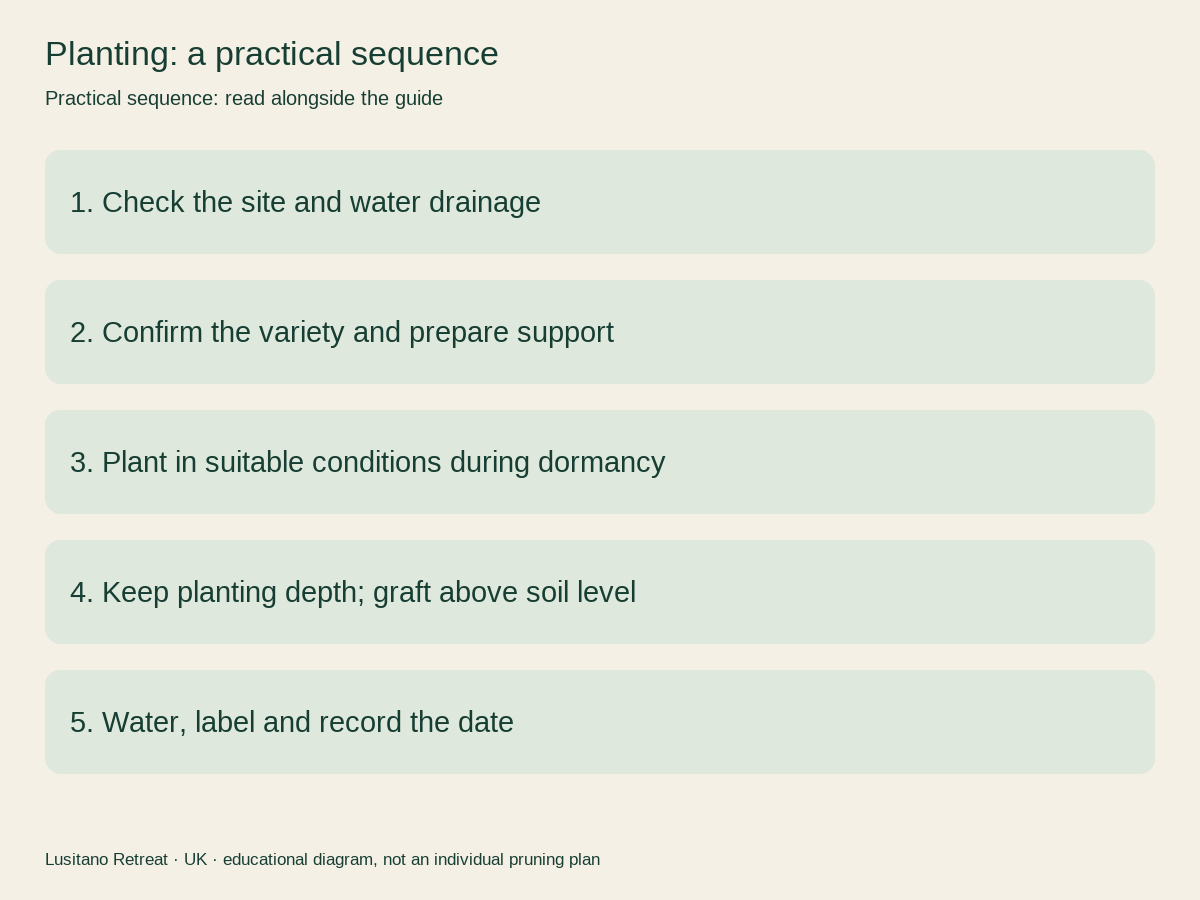
Choose a sunny, sheltered position away from frost pockets and standing water. Check drainage after rain and the site’s history. Install suitable support first; do not rely on an improvised net to carry a mature vine. Against a wall, allow for its rain shadow and access for watering. [G5]
The RHS recommends planting while dormant, usually November to early March; early spring can reduce winter damage to young plants. Do not plant into frozen or waterlogged ground. Set a container-grown vine at its previous depth and keep any graft union above the soil. [G1]
Working sequence: check roots and label → size the hole for the roots → position the vine → backfill and gently firm → water → tie loosely to the support → record the date. Do not add fertiliser or lime without establishing a need; adding gravel to a planting hole alone does not fix a waterlogged site.
04 / The research
Ground, container or greenhouse?
In the ground, assess rooting space, sun and late frosts. For a container, plan drainage, stability, watering during absences and winter protection of the root ball. The container must suit the eventual plant; a small shop pot is not a permanent growing position.
Under glass, monitor ventilation, temperature and access to water. Roots inside a protected structure receive water differently from roots in open ground. Do not assume rain is watering a greenhouse vine. [G6]
When buying, check whether the cultivar is a dessert or wine grape and whether it needs protection. Mature wood and winter hardiness are not the same as the ability to ripen sweet fruit in a short summer. [G1]
05 / The research
UK calendar: months, not fixed dates
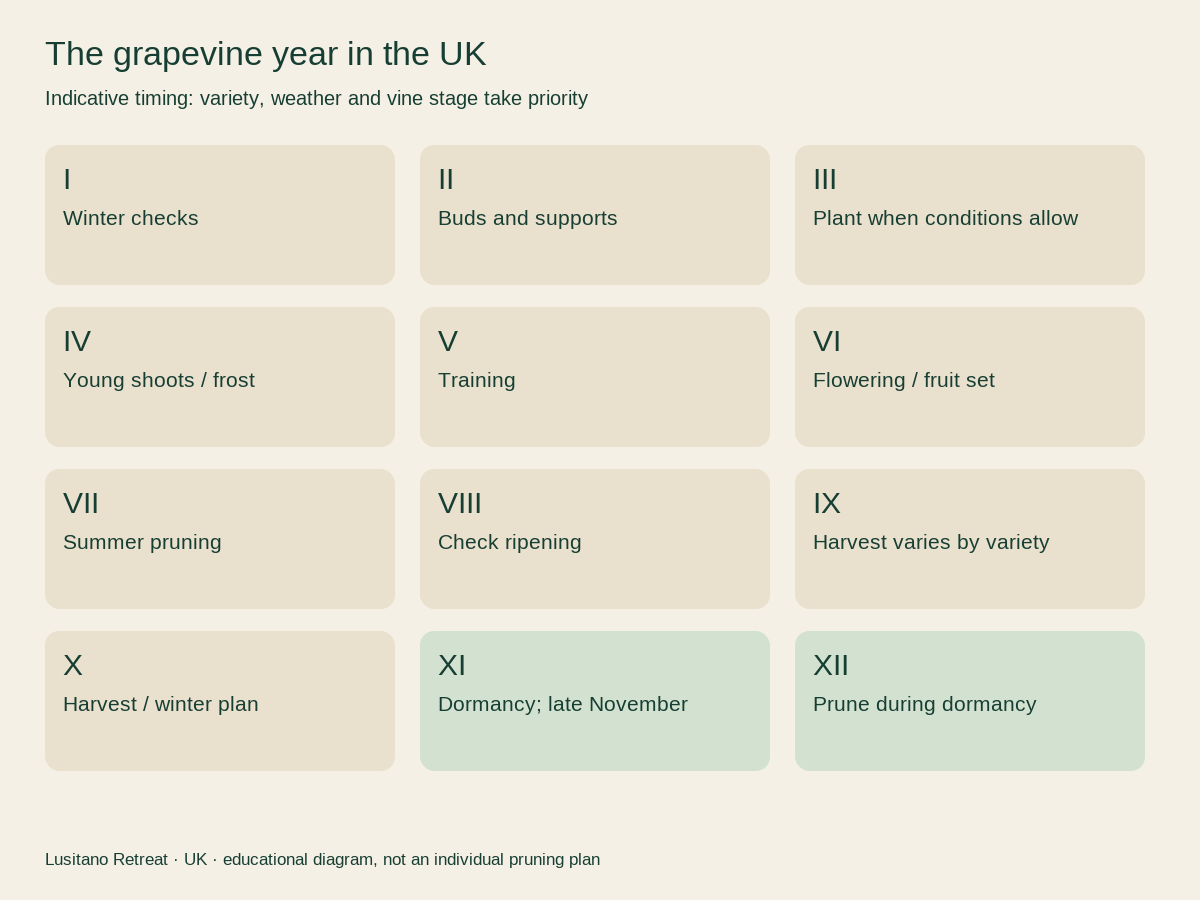
This table is our indicative garden-check schedule, not a phenology model for a specific cultivar. Greenhouse stages may arrive earlier; a cool site can delay growth and harvest. Check the RHS timing for your chosen training system. [G2]
| Month | Task / condition |
|---|---|
| January | Check supports, ties and dormancy; do not routinely postpone greenhouse pruning until late winter. |
| February | Check young plants, drainage and protection; assess sap-bleeding risk before major late pruning. |
| March | Plant in early spring if conditions allow; watch bud development and frost forecasts. |
| April | Check new shoots and frost risk; train and water new plantings. |
| May | Tie in developing shoots; retain the renewal shoots needed by your chosen system. |
| June | Check flowering, fruit set, airflow and crowding; apply green pruning appropriate to the system. |
| July | Check leaves, bunches, root-zone moisture and crop load; do not strip the vine. |
| August | Watch early cultivars for ripening; assess flavour, condition and softening rather than colour alone. |
| September | Harvest if ready; expose bunches selectively if needed without removing leaves en masse. |
| October | Finish harvesting if the cultivar is ready; record problems and prepare the winter plan. |
| November | Plant dormant vines; main pruning usually starts late in the month once fully dormant. |
| December | Typical winter pruning window; complete planned work when conditions are suitable. |
06 / The research
When to prune in winter — and when to wait
The RHS standard window for cordon and Guyot is full dormancy in early winter, usually late November and December. Do not treat 1 December as a mandatory date. Assess the vine and safe access before starting. [G3] [G4]
Pruning in late winter or spring can cause heavy sap bleeding, particularly under glass. Do not try to stop it by making further cuts. Sites prone to late frosts may need a different delayed-pruning strategy; plan this exception with an experienced grower rather than applying it universally. [G4]
07 / The research
Before cutting: trunk, cane, bud and green shoot
The trunk and permanent arm form the long-lived framework. A cane is a woody shoot from the previous season; buds are points of future growth. A current-season green shoot may carry bunches. A spur is a short section retained after pruning. Not everything old and brown is redundant.
Before pruning, walk around the vine and trace each candidate back to its base. Mark: retain framework, retain renewal, remove after confirmation. The diagrams show principles, not a ready-made cutting map for your vine. [G2]
08 / The research
Two training systems, two different plans
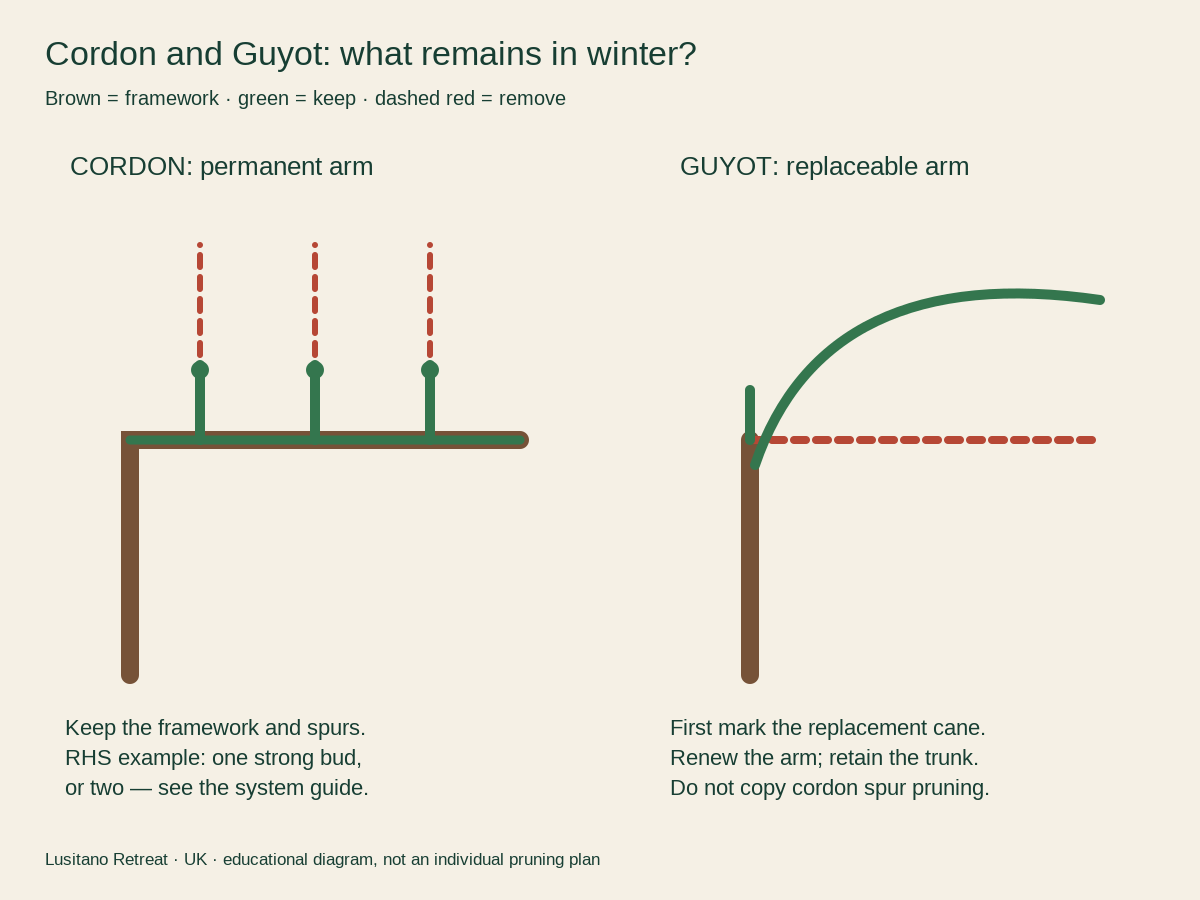
Cordon: retain the permanent framework and short spurs. Guyot: retain a short trunk, but renew the fruiting arm from a selected cane. The first often suits a wall or greenhouse; the second suits rows. Do not mechanically combine instructions from both systems. [G2]
Write the system on the label and photograph the vine before and after. Do not remove a cordon’s main arm merely because a Guyot video removes an arm after fruiting. Do not shorten every Guyot cane to a short spur: you may lose the necessary renewal growth.
09 / The research
Cordon: example winter pruning of an established vine
Identify the permanent trunk or arm and existing spurs. In the RHS dormant-season rod-and-spur example, side shoots are shortened to one strong bud, or two if the first looks weak. The necessary framework is retained. This instruction is for rod-and-spur training, not every vine. [G3]
Clean the secateurs, identify the bud and make one clean cut above it without damage. Do not start by making large wounds in unidentified old wood. For a neglected vine or unclear framework, make an individual plan rather than copying the same bud count across the plant.
10 / The research
Guyot: retain a cane for next season
On an established Guyot vine, the arm that produced fruiting shoots is removed and replaced with a selected mature cane. The arm is tied gently to the lowest wire; a central renewal element is also needed. Before cutting the old arm, find and mark its replacement. [G4]
Do not sharply bend brittle wood. Check the bases, ties and available coverage. Bud numbers, arm length and crop load must suit the system and vine vigour; our diagram deliberately does not specify a universal number of cuts.
11 / The research
Summer green pruning: do not strip every leaf
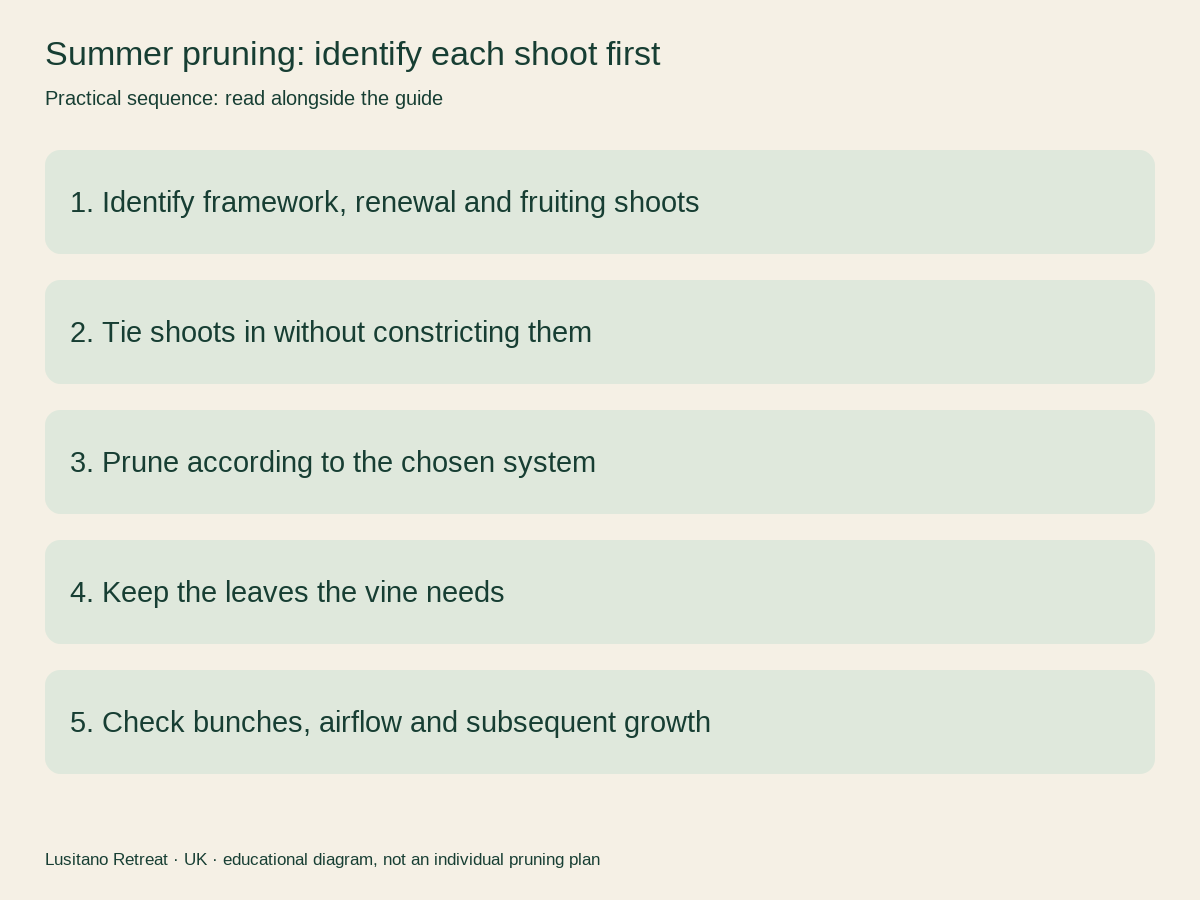
Tie in and organise shoots as they grow. In the RHS example for an established cordon, selected fruiting shoots are shortened to two leaves beyond the developing bunch; secondary growth is managed separately. Do not apply that number as a winter rule for Guyot. [G3]
First identify whether a shoot is fruiting, structural or for renewal. Work gradually and retain the leaves that feed the plant. Excessive exposure of bunches does not automatically make them sweeter. Mark renewal shoots before tidying.
12 / The research
The first years: establish roots and structure first
A young vine is not a miniature version of the mature plant in a video. It needs its own training plan and stable support. Do not burden a poorly established vine with a large fruit load. Plan training over successive seasons and assess actual growth. [G2]
Our check sequence: after planting, label and water → in the first season, establish a healthy leader and ties → in winter, assess the framework → in the next season, develop the chosen system. If growth is weak, check roots, water and position before adding more cuts or fertiliser.
13 / The research
Watering, mulch and feeding
Check newly planted vines during dry spells. Rain does not reach evenly beneath a wall, and a container needs its own checks. Do not set a fixed number of litres without measuring and assessing the soil. Record moisture, watering and leaf condition. [G5]
Under cover, monitor regular watering and ventilation. Base fertiliser choice and dose on the growing medium, symptoms, product label and plant stage; do not feed blindly to speed ripening. [G6]
Keep mulch away from the trunk. Use the existing watering and bed-preparation guides, but remember that a mature vine has a different root system from a newly raised seedling.
14 / The research
Diseases: inspect both sides of the leaf
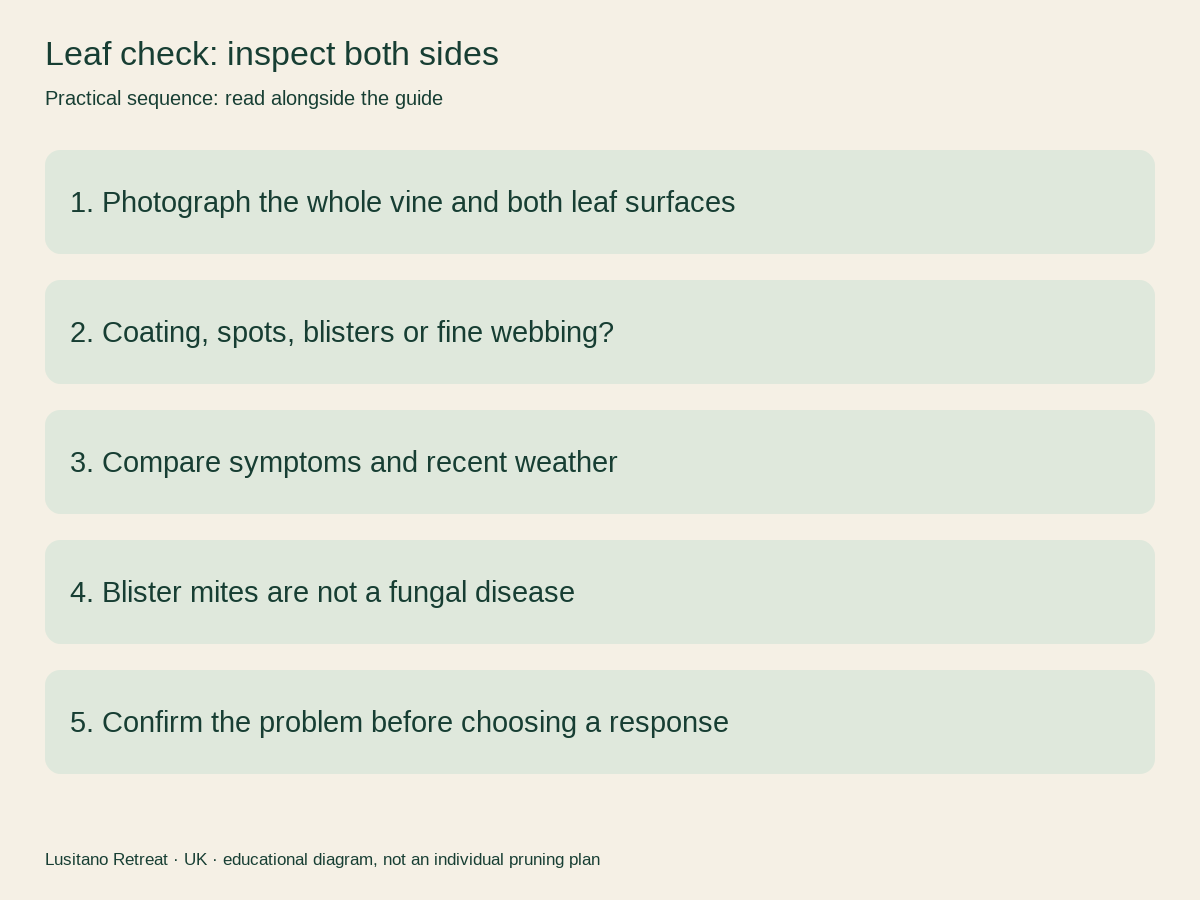
A symptom is not a diagnosis. Note the date, weather, cultivar, pattern of changes and condition of bunches. Take clear photographs of the upper and lower leaf surfaces and the whole plant. Do not spray everything merely because a leaf is yellow. [G7]
| Symptom to compare | Possible issue | First step |
|---|---|---|
| White powdery growth on leaves or fruit, sometimes split berries | Powdery mildew — confirmation needed | Check airflow and crowding; inspect bunches too. [G7] |
| Yellowish patches with whitish growth beneath, especially after wet weather | Downy mildew — confirmation needed | Inspect undersides, avoid unnecessary leaf wetting and collect affected fallen leaves. [G7] |
| Soft browning berries and fluffy grey growth | Grey mould — confirmation needed | Separate affected fruit, improve airflow and check adjacent bunches. [G7] |
| Raised blisters and cream or pink felt beneath | Grapevine blister mite, not necessarily a fungus | Usually tolerable; do not strip the vine. [G8] |
| Fine pale speckling, mites beneath leaves and delicate webbing | Spider mite, especially under glass | Confirm with a magnifier; check conditions and biological-control options. [G9] |
| Yellowing without a characteristic coating | Water, roots, nutrition or other causes | Assess drainage, watering and symptom history; do not diagnose from colour. |
15 / The research
Prevention and a measured response
Collect affected fallen leaves and monitor airflow and crowding. Water the root zone. Under glass, do not manage spider mites by keeping leaves constantly wet: fungal disease risk also needs to be controlled. This is a practical inference from combining the guidance, not a universal prescription. [G7] [G9]
For limited blister-mite symptoms, do not strip leaves en masse; excessive removal can harm the vine more than the problem itself. [G8] For rapidly dying shoots, unexplained trunk changes or major losses, seek identification using photographs or a sample.
This guide does not prescribe a spraying programme. If considering a product, check current authorisation for edible grapevines, its label, harvest interval and correct diagnosis. A chemical name from an overseas video is not enough.
16 / The research
When to harvest and what to do with bunches
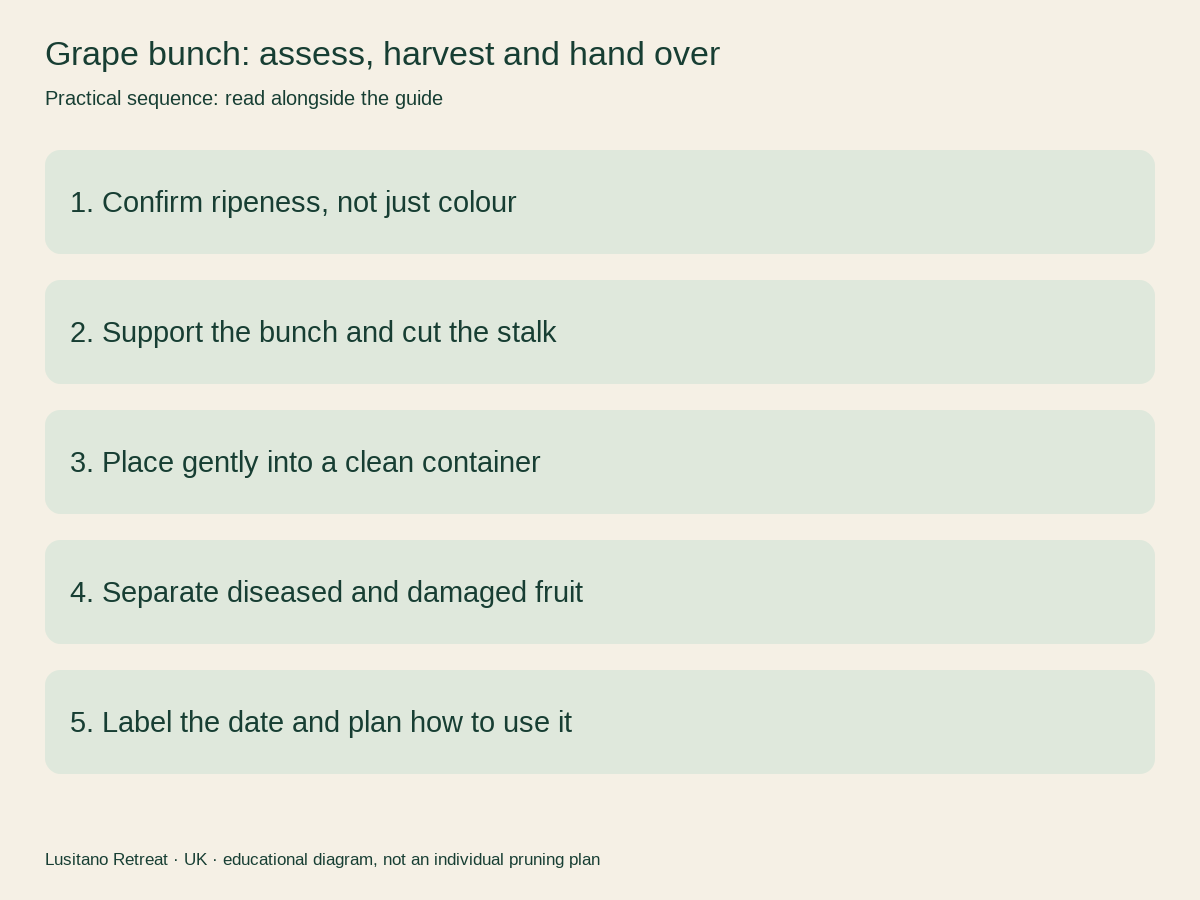
Observe the cultivar and taste healthy fruit from different parts of a bunch when it appears ready. Green, red or dark colour alone does not prove ripeness. The RHS gives a broad August–October period depending on cultivar and conditions. [G1]
Our batch procedure: prepare clean scissors and a shallow container → support the bunch → cut its stalk → place it down without crushing → reject mouldy or damaged fruit → label date and intended use. Do not make reserves from diseased bunches or claim a shelf life without knowing the storage conditions.
Pass batches to the kitchen using the existing harvest card. Wash food with appropriate water before eating or preparation. Juice, raisins or wine need separate processes; this calendar is not a preservation method or an authorisation to sell alcohol.
17 / The research
Equipment and a record for one vine
Start with photographs and measurements of the support. This is a working kit list, not a purchase order or structural design. Do not prune at height without safe access.
| Task | Equipment | Check |
|---|---|---|
| Pruning | Sharp secateurs, gloves, tool cleaner used according to its instructions | Clean blades and identify the bud and shoot before cutting |
| Training | Stable support, soft ties, labels | Ties do not cut in; no loose sharp wires |
| Observation | Phone, magnifier, notebook, optional min/max thermometer | Photograph upper and lower leaf surfaces; record date, weather and treatment history |
| Watering | Watering can or suitable line, checked drainage | Root zone neither too wet nor too dry |
| Harvest | Clean scissors, shallow container, label | Place fruit gently and separate it from diseased fruit |
18 / The research
How to use the videos and notes
The three short videos are educational slides with Polish synthetic narration. They do not show an operation on your own vine. Watch the calendar first, then the training-system comparison and finally the leaf diagnosis. Transcripts are available to read.
After watching, fill in a record: vine number, cultivar or unknown, position, age, system, date and photographs. Choose a task that matches the actual stage. Unidentified material or an unclear framework calls for advice before major pruning, not guessing.