
01 / The research
1. Start with a named job and an accountable person
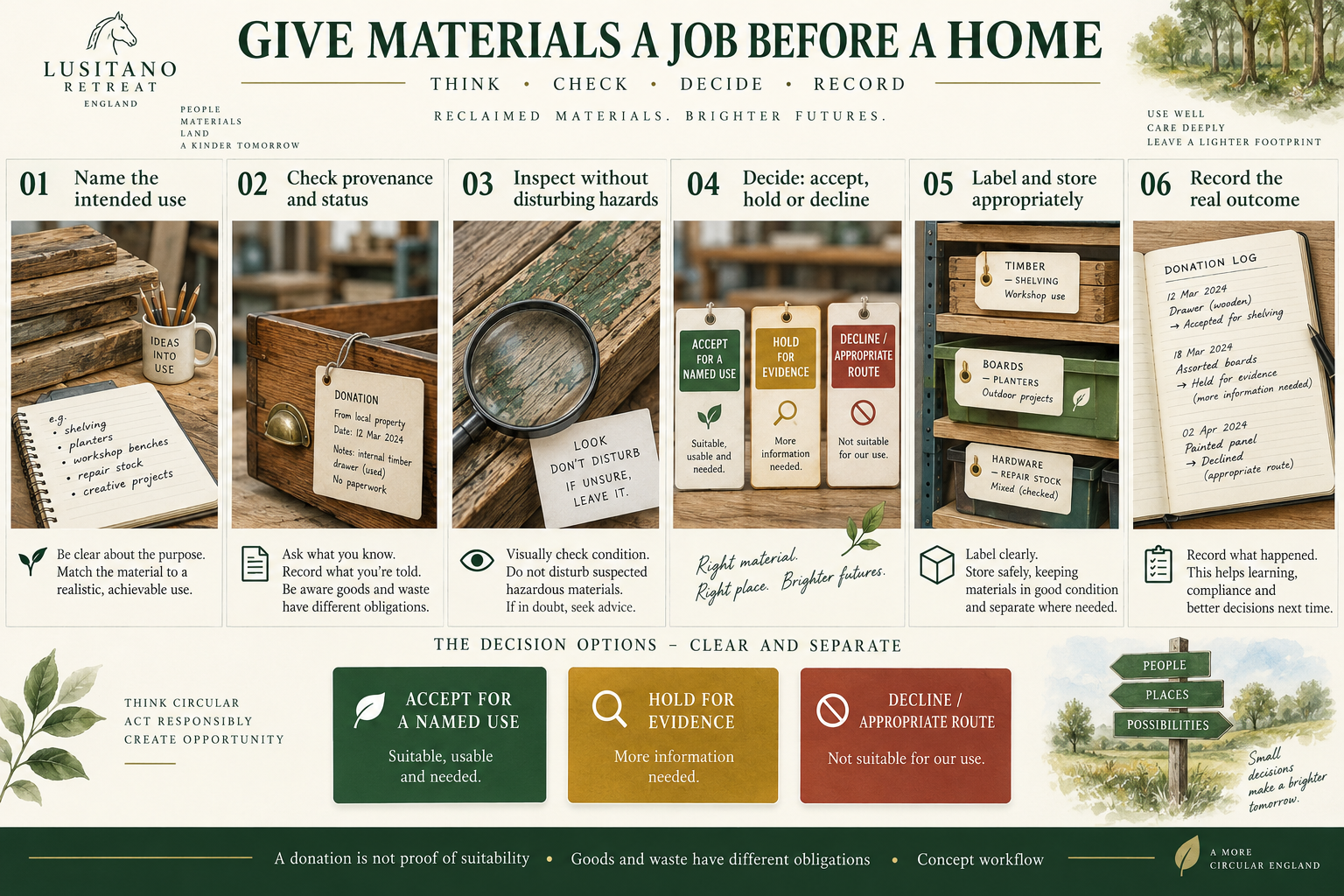
For the retreat, a useful first stockroom contains materials matched to real projects: a sound drawer for a light desktop organiser, suitable boards for removable inserts, or a serviceable cabinet for dry workshop supplies. Write the proposed job before collecting the object. A possible future use is not an instruction to accumulate unlimited stock.
Name an intake coordinator to organise records and a project lead to decide whether an item suits its intended task. These roles do not make either person a structural grader or hazardous-material specialist. Refer specialist questions to someone competent for that question. Begin with the smallest batch the available space and real project can accommodate.
02 / The research
2. Establish the material’s status before collection
Second-hand goods are not automatically waste. Equally, a donation, a sale price or the word reclaimed does not settle the issue. England’s Environment Agency considers the circumstances of discard and intended use. Its reuse route includes conditions concerning the same original purpose, intended reuse, limited repair and lawful use. Turning discarded material into a different product needs its own assessment; a creative idea alone does not establish non-waste status. [M1]
Before accepting a load, establish whether it is usable goods or waste and whether the proposed collection, transport, storage and processing are lawful. Where waste is involved, duty-of-care and environmental-permitting requirements may apply, including any genuinely applicable exemption conditions. Free delivery is not an exemption. This proposed workflow authorises no waste operation. Do not start receiving uncertain loads while awaiting an answer. [M2] [M3]
03 / The research
3. Ask for history, photographs and a realistic description
Request photographs of the whole item, underside, labels, damaged areas and any coating or deposit. Ask its previous use, where it was kept, whether it has been treated, and why it is available. Record what the supplier actually knows and what remains unknown. A timber stamp or attractive weathered appearance does not reveal every later exposure or treatment.
Keep the collection reference linked to the project, but keep contact details in an appropriate private record. Public episode notes can use an item identifier and a non-identifying description. Confirm permission to take the object. Agree what is being supplied; a photo of one good board is not evidence about a mixed trailer of demolition material.
04 / The research
4. Inspect without creating a new exposure
Start with observation: loose joints, broken edges, embedded fasteners, damp areas, infestation signs and suspect residues. An unknown coating is a reason to pause preparation, rather than test it with a sander. Suspect asbestos-containing material requires stopping disturbance and appropriate advice; do not cut, break or sample it as a workshop experiment. [M5]
Before any approved machining, assess the actual work and material. Check for hidden metal using suitable inspection methods; a detector result does not certify that a board is metal-free. Arrange task-appropriate dust controls. HSE identifies serious health risks from wood dust and describes control measures; ordinary tidiness or a generic mask choice cannot replace that assessment. [M4]
05 / The research
5. Match each accepted item to a limited application
Acceptance is specific to a use. A cabinet suitable for light dry storage is not thereby suitable for supporting a tank. Keep structural, hot-room, food-contact and wet-service applications outside ordinary workshop acceptance until their particular requirements have been assessed.
Use this table to organise questions, not as a material certification. Changing the job requires another suitability decision.
| Candidate material | Possible limited job | Questions before acceptance |
|---|---|---|
| Sound drawer | Removable organiser on a stable worktop | Base, joints, edges, surface history and intended light contents |
| Traceable boards | Measured removable compartments | Treatment, defects, concealed metal and suitability for preparation |
| Serviceable cabinet | Dry workshop storage | Stability, doors, fixings and suitability for the actual contents |
| Unknown painted demolition timber | No workshop job assigned | Material status, coating and contamination assessment before collection or disturbance |
| Old structural timber | Assessment candidate only | Traceability, condition and competent design/grading for the proposed structural use |
06 / The research
6. Separate accepted stock from unresolved material
Store accepted items so their condition and labels remain visible. Separate material awaiting assessment from ready stock; if an unexpected suspect item is already present, restrict access and obtain appropriate advice rather than moving or working it unnecessarily. A labelled holding area does not make otherwise unauthorised waste storage lawful.
Record moisture readings with the instrument, settings, measurement locations and conditions. Compare repeated observations and the requirements of the intended application. No single moisture percentage approves every reclaimed species, thickness, coating or installation. Plan storage and any conditioning to preserve suitability; do not cover damp stock in a way that conceals deterioration.
07 / The research
7. Keep one material record from arrival to outcome
Use a single stock record linked to the existing mission rather than a second unrelated tracker. Minimum fields are item or batch identifier, source reference, previous use, collection permission, material-status assessment, photographs, actual quantity, dimensions, condition, treatments known or unknown, intended project, decision maker and review date.
Add the present location, unresolved questions, inspection or specialist evidence, actual additions and expenditure, and the final destination. Use clear states: proposed, awaiting assessment, accepted for named use, used, or transferred through an appropriate route. Blank costs and unknown quantities remain unknown. Do not turn a receipt into evidence of suitability or record carbon savings without a defensible method.
08 / The research
8. Film the decision as well as the transformation
The show sequence can begin with the proposed job, then the evidence, the inspection decision, a layout trial and the recorded outcome. Chapters 8 and 9 can show the material journey; chapter 20 can revisit what remained useful. Film labels without private supplier information and give practical work the attention it needs.
If an item fails assessment, the episode can explain the decision and the appropriate next route. Do not burn unknown treated wood, conceal rejects in a new build or pass uncertain material on as approved stock. Where disposal involves waste, use the applicable classification, authorised recipient and transfer arrangements. Recovery and preparing for reuse are distinct from simply transferring a serviceable second-hand object. [M2]
Close each mission with evidence of the actual result: retained parts, added parts, time, expense and outstanding questions. The 21 chapters organise the story; they do not promise a completed retreat or a lawful operating materials centre in 21 days.