The making library · England
Research checked 13 October 2026 · Concepts to assess
A second life.
A sound first decision.
Practical research for a place made with repair, reclaimed materials and care.
How could a caravan become a timber-finished retreat? What changes when it sits on a farm? And what would it take to add a sauna or a small living-water system? These guides put the attractive idea beside the decisions needed to make it work.
Our UK site is still being explored. These are proposed projects, not completed builds, site-specific approvals or a promise that a retreat can be built in 21 days. Planning discussion covers England; other UK nations have different systems.
Four starting points
From the idea to the next question.
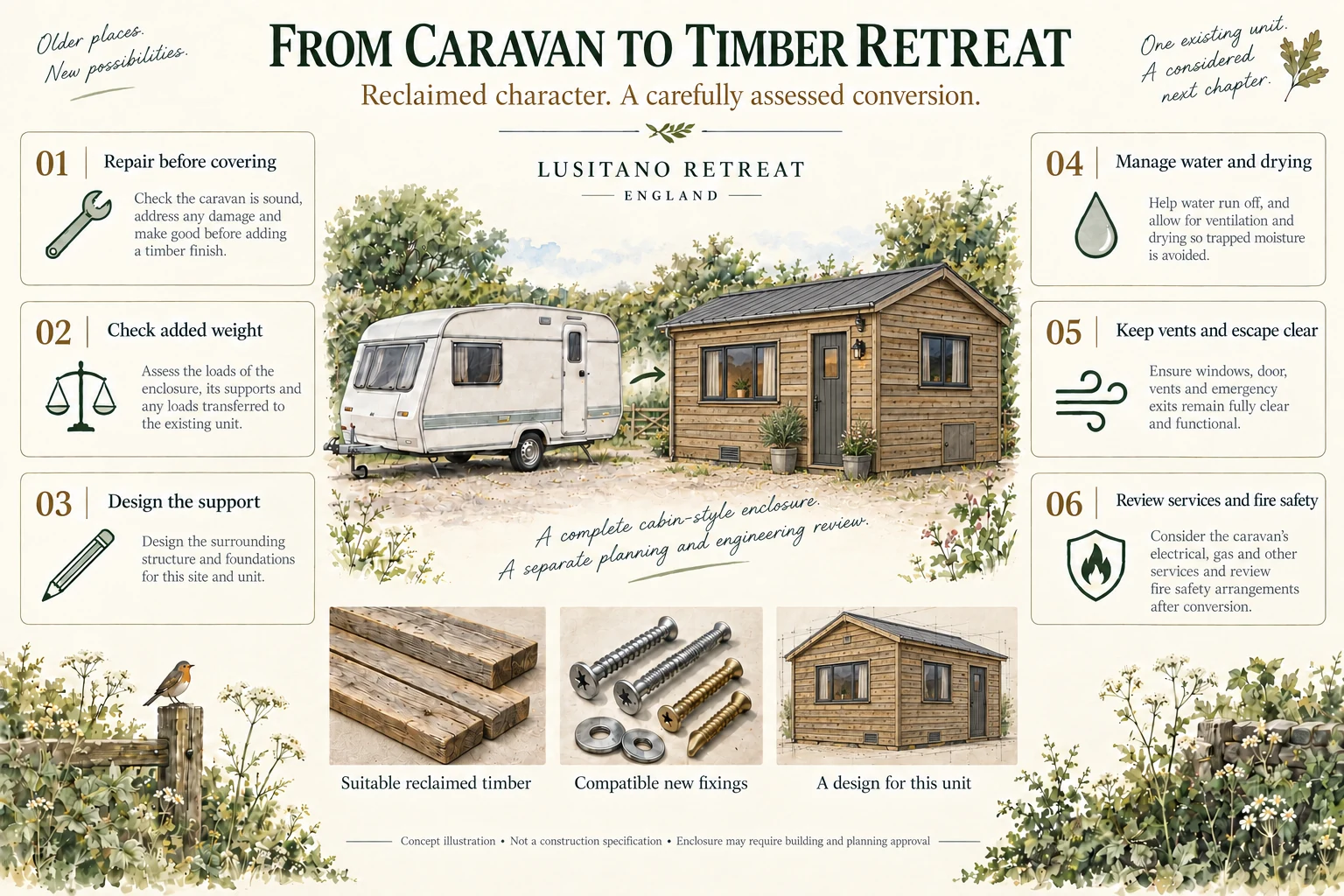
01 / Build guide · England · researched 13 October 2026
A complete rectangular timber cabin enclosure conceals the donor caravan. Explore useful interior zones, reclaimed-material choices, measured design inputs and a staged route from condition survey to an assessed finished proposal.
Concept and assessment guide. No donor caravan, site-specific design, conversion approval or quoted project cost is confirmed.
Read the research and source notes →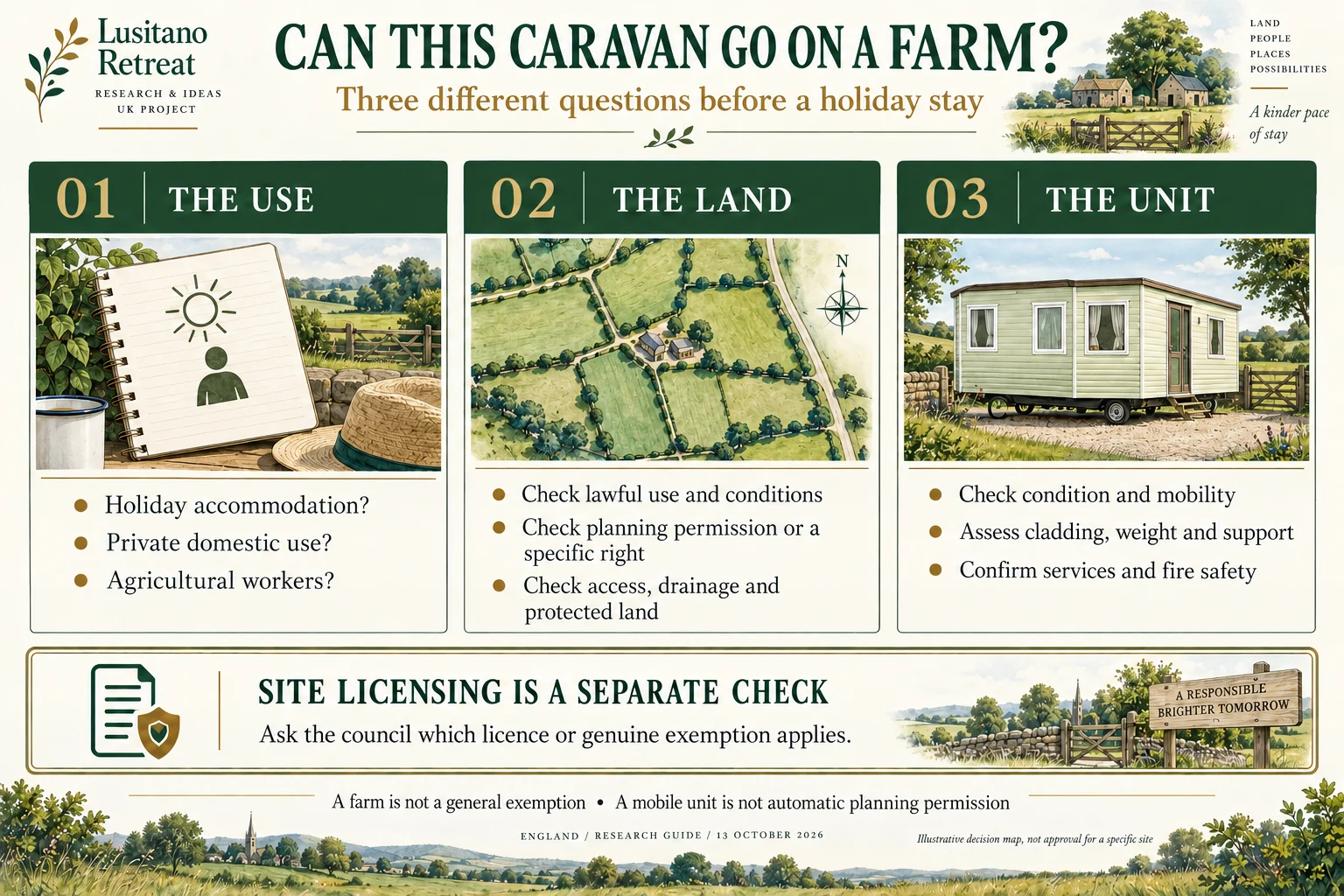
02 / Land and permissions · England · researched 13 October 2026
A farm, an attractive timber exterior and caravan dimensions do not establish permission. Match the intended occupants and site to a lawful planning route, then resolve licensing and the works around it.
England decision guide, not approval of a parcel. No named farm, holiday operation, residential occupation or exemption is confirmed.
Read the research and source notes →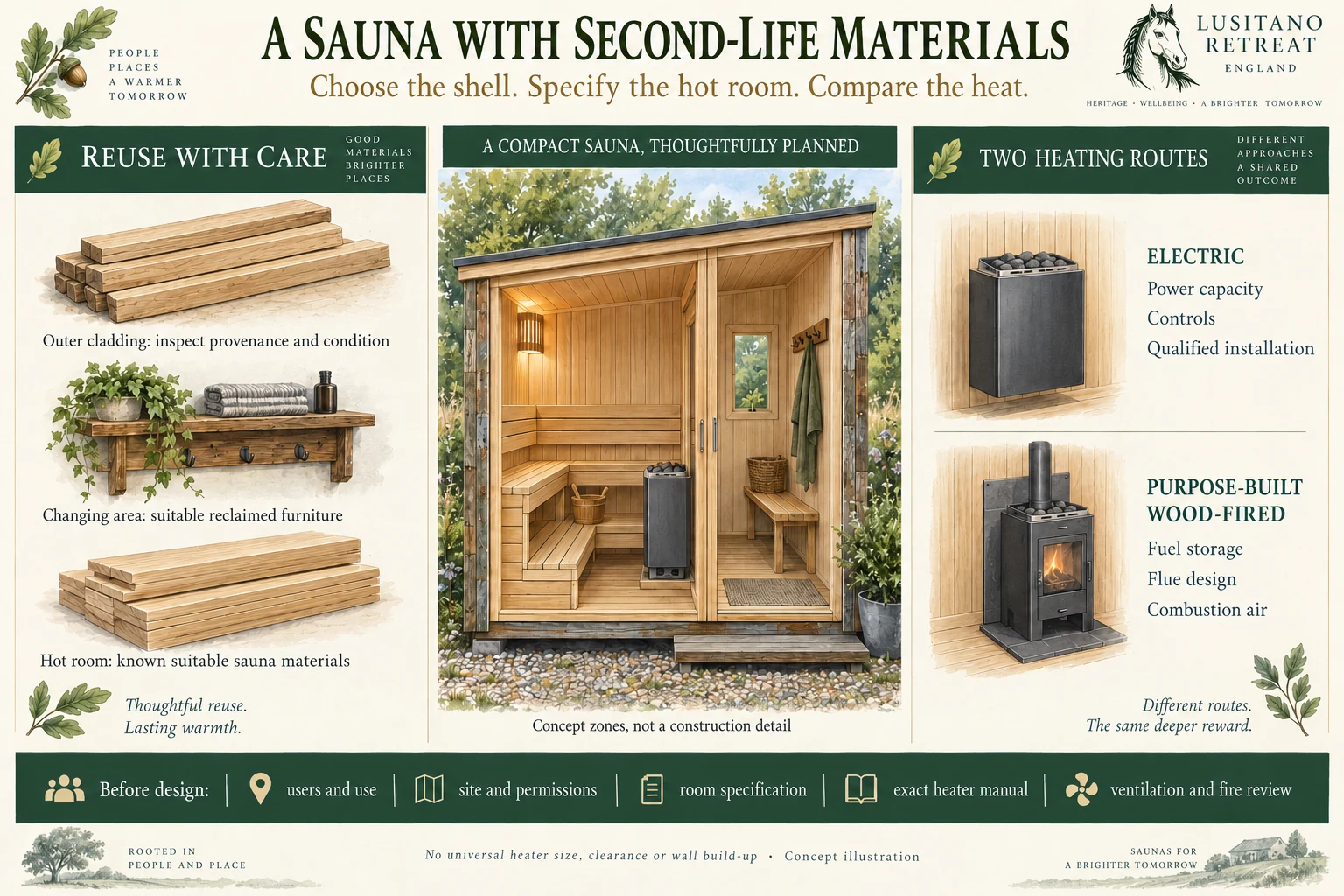
03 / Sauna concept · UK design questions
Compare heater routes, choose where reuse belongs and prepare a coherent specification before building a sauna for a British countryside project.
Research and design guide. No site, system or installation approved. Sources checked 13 October 2026; planning and EA references are principally for England.
Read the research and source notes →04 / Aquatic systems · feasibility before stocking
Distinguish ponds, freshwater recirculation, aquaponics and shrimp production, then map the permissions, water, daily care and failure response.
Research and feasibility guide. No stocked system or output claimed. Sources checked 13 October 2026; FHI scope is England and Wales, EA guidance here principally England.
Read the research and source notes →The approach
Design around what is worth keeping.
Know the material.
Source, condition and the intended job come before the transformation. An old board can have character and still be unsuitable for heat, moisture, structure or food contact.
Count the whole system.
Transport, new fixings, specialist work, energy and maintenance all belong in the budget. Reclaimed materials are part of the design; they do not remove performance requirements.
Show what actually happened.
Keep the before picture, the measured change and the decisions. A reason to pause is a useful result, and a concept image remains a concept image.
The Lusitano Diaries · The 21-day sprint reimagined
A technical question.
A documentary chapter.
The original sprint becomes 21 proposed chapters at the pace of real work. Each guide can support several episodes: the first question, the investigation, an assessed trial and the honest review. Construction, planning and living systems follow their own timescales.
01Chapters 01–07
Read the site and the rules
Start with the actual property, proposed use and material history. Record the questions that a planning officer, owner or competent specialist needs to answer.
Explore the chapter brief →02Chapters 08–14
Try one assessed transformation
Choose a modest, useful project whose materials, design and working conditions are understood. Record dimensions, time, new components and what changes after the first attempt.
Explore the chapter brief →03Chapters 15–21
Review before growing
Keep the evidence, including the reasons to change course. Larger guest spaces, a sauna and living-water systems each need their own site and technical assessment.
Explore the chapter brief → 