
01 / The research
Answer four different questions
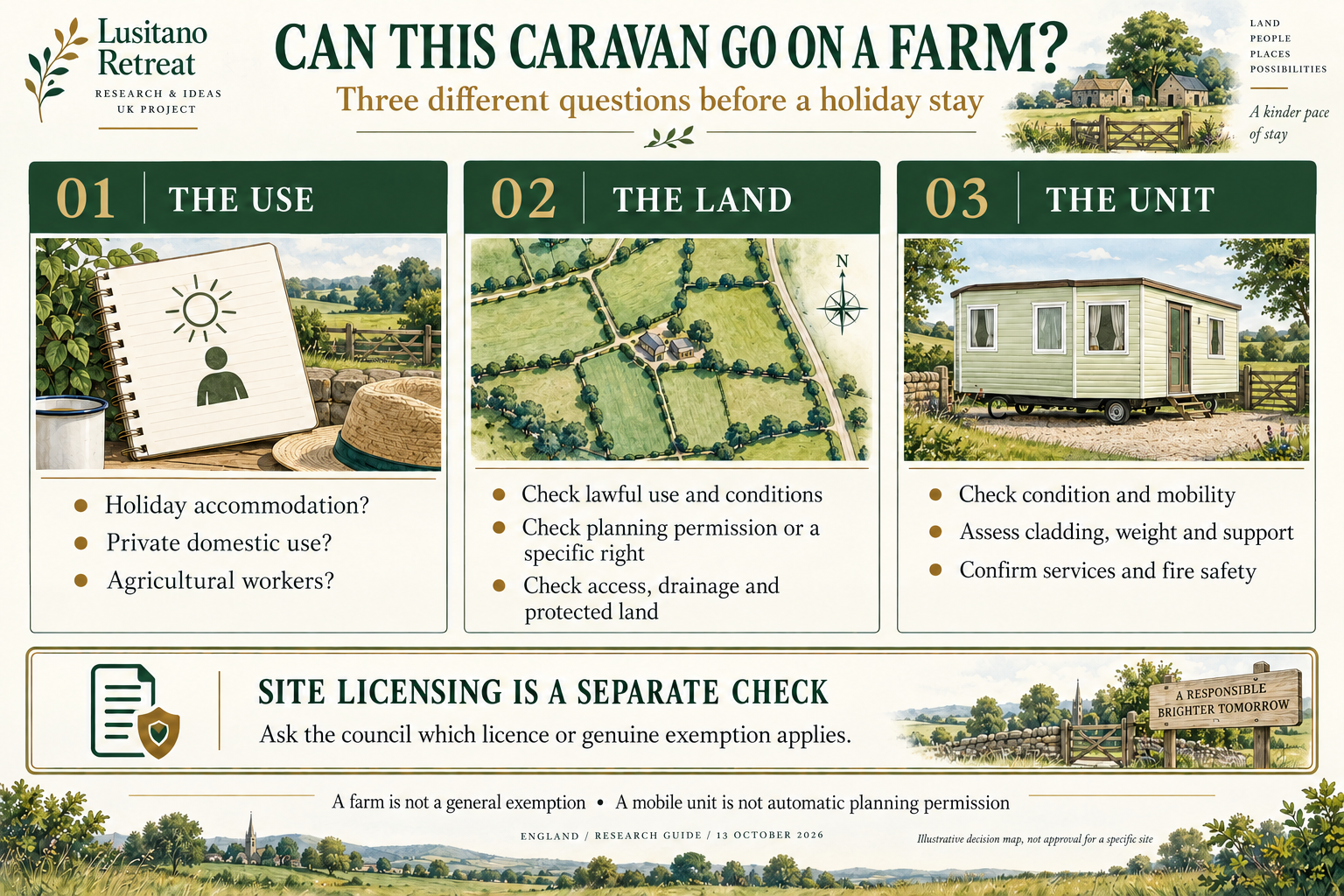
First, is the completed object a caravan in law? Second, is its proposed use on that land lawful for planning purposes? Third, is a caravan site licence required or does a particular exception apply? Fourth, what permissions and safety arrangements are needed for associated works and operation? A positive answer to one does not answer the others. [C2-1] [C2-2] [C2-9]
Describe who will stay, whether they pay, whether it is their home, how many units are proposed, when they are stationed and when they are occupied. Add access, drainage, decks, external frames and services to the description. This guide addresses England; do not export the route to another UK nation without checking its rules.
02 / The research
Dimensions are not development permission
The 1960 definition concerns a structure adapted for habitation that can move between places, by towing or transport. The 1968 twin-unit provision addresses no more than two separately constructed sections designed for assembly and physical movement by road when assembled. Its consolidated limits are 20 metres long excluding the drawbar, 6.8 metres wide and 3.05 metres internally from the lowest floor to the highest ceiling. These are not general maximum dimensions for a planning-free cabin. [C2-2] [C2-3]
The twin-unit provision recognises physical movement even where the assembled unit cannot lawfully travel on the highway in that form. That is different from road-towing compliance. Timber cladding, an independent surround or other additions require assessment of the completed arrangement; wheels or nominally detachable boards are not conclusive. [C2-3]
03 / The research
Match the farm to the proposed use
This matrix is an initial investigation tool. “Potential route” means a question to verify, not a finding that a property qualifies. Keep the actual decision notice, approved plan and conditions beside the site map. [C2-9] [C2-10]
| Site/use scenario | Potential route to investigate | What must not be assumed |
|---|---|---|
| Existing authorised holiday-caravan pitches | Check the exact permission, site licence, pitch limits and proposed replacement | A holiday pitch permits a permanent home or any larger clad unit. |
| Farmhouse domestic curtilage, genuinely incidental household use | Assess the household relationship and possible proposed-use certificate | All land owned with the farmhouse is domestic curtilage. |
| Agricultural field proposed for paying retreats | A suitable holiday-site planning proposal and licensing assessment | Agricultural permitted development authorises tourism. |
| Seasonal agricultural-worker accommodation | Assess the precise worker/season exception and linked planning right | A retreat visitor or year-round owner qualifies as a seasonal farmworker. |
| A genuine approved recreational-club site | Verify the organisation certificate, site certificate and actual permitted operation | Certification permits an unrestricted operator-owned holiday village. |
| Land meeting a narrow short-stay exception | Check every statutory limit and whether rights/exemptions have been withdrawn | A large field creates an open-ended residential or holiday entitlement. |
| Farm with protected landscape, heritage, flood or habitat constraints | Investigate the applicable policy, statutory constraints and technical evidence | Farm ownership, screening or recycled timber cancels protection. |
04 / The research
Holiday guests, a home and ancillary household use
A holiday accommodation consent is not permission to make the unit a main residence. Check permitted seasons, holiday-only conditions, named or occupational restrictions, pitch plans and any record-keeping requirements in the actual documents. A site that operates throughout the year may still prohibit residential occupation. Owner or employee accommodation can have a different specific position; do not infer it from marketing language. [C2-12]
A genuinely incidental use within a dwellinghouse curtilage can fall outside development under section 55(2)(d), and First Schedule paragraph 1 separately concerns incidental domestic use for licensing. Neither provision makes the whole farm a residential garden. An independent household, separate letting or commercial retreat activity needs its own assessment. [C2-1] [C2-4]
An Inspectorate decision concerning an ancillary caravan examined its functional relationship with the main home and controlled occupation accordingly. The unit having domestic facilities was not by itself decisive. This illustrates fact-sensitive assessment, not a precedent approving another garden or a commercial use. [C2-16]
05 / The research
Read the limited exceptions literally
First Schedule paragraph 2 concerns a person travelling with one caravan for no more than two nights, with no other habitation caravan on the land/adjoining land in the same occupation and a 28-day rolling 12-month condition. Paragraph 3 concerns at least five acres including qualifying adjoining unbuilt land, no more than three caravans at a time and 28 habitation-stationing days in the rolling 12 months. It is not 28 days per caravan. [C2-4]
Paragraph 7 addresses accommodation during a particular season for people employed in farming operations on land in the same occupation; paragraph 8 concerns forestry. Paragraph 9 relates to workers on qualifying building/engineering operations. These are use-specific exceptions, not a route for retreat guests. Paragraph 13 permits specified exceptions to be withdrawn for particular land. [C2-4]
Crucially, some exceptions also have a planning route: GPDO Part 5 Class A covers the circumstances in First Schedule paragraphs 2–10, excluding the paragraph 10 winter-quarters case. It requires the use to stop and caravans to be removed as soon as reasonably practicable when the circumstances end. So “a licence exemption never affects planning” would also be wrong. Check both instruments, their conditions and any removal of rights. [C2-5]
06 / The research
The 60-day campsite rule is not a timber-caravan rule
Class BC of GPDO Part 4 allows a qualifying recreational campsite for up to 60 days in a calendar year, with no more than 50 pitches. It excludes siting caravans except those used as motor vehicles designed or adapted for habitation. Tents and qualifying motorhomes/campervans are therefore different from a touring caravan or static timber-clad caravan. [C2-6]
It requires toilet/waste facilities and advance annual notification with the site plan and operating dates. There are exclusions, including listed-building sites, scheduled monuments and SSSIs; Flood Zones 2 and 3 require the specified annual prior-approval route. It is not a blanket campsite entitlement. Class B also does not give an ordinary caravan a general 28-day siting right; its relevant festival exception is for habitation motor vehicles. [C2-6] [C2-7]
Keep the clocks separate in a site diary. Class BC uses a calendar year; the relevant First Schedule short-stay conditions use a rolling 12-month period. Vacancies, changing the person staying or moving a unit around one holding should not be treated as resetting statutory limits. Obtain an interpretation of the actual proposal before relying on a temporary route.
07 / The research
A club certificate is a specific operating model
Natural England describes separate organisation-based routes. Paragraph 5 approved sites are for members’ recreation, with a maximum of five caravans and certificates lasting up to one year. Paragraph 6 meetings/rallies are supervised member events lasting no more than five days. The organisation must meet the applicable requirements; a landowner cannot simply self-declare certification. [C2-8]
Ask the certificate holder whether the actual business model, including any operator-owned hire units, is compatible. Do not assume that adding a membership label makes a private holiday-let business eligible. The guidance also warns that additional infrastructure, such as toilet blocks or parking, is not covered automatically. [C2-8]
08 / The research
Agricultural status and attractive materials do not override constraints
GOV.UK explains that farms remain subject to planning regulation and changing farming land/buildings to another use needs the appropriate permission. Part 6 agricultural rights concern qualifying works reasonably necessary for agriculture; they exclude dwellings and non-agricultural-purpose structures in the relevant Class A provisions. A tourist cabin is not agricultural infrastructure because its guests enjoy the farm. [C2-10] [C2-11]
Check the current local plan, Green Belt, National Park or National Landscape/AONB, heritage designations, habitats, flood risk and local directions. Green Belt and protected-landscape policies can materially affect the proposal; timber, concealment or a small unit count does not itself overcome them. Conversely, do not label every protected-area proposal automatically prohibited without assessing the actual route and policy. [C2-14] [C2-15]
09 / The research
Prepare the parcel evidence before the purchase decision
Our suggested evidence pack starts with the planning-unit boundary and lawful existing use, decision notices/conditions, licence or certificate, access rights, drainage options and the proposed unit/works drawings. Include a simple occupancy statement and calendar. Check title, tenancy, lender, insurer and seller restrictions separately; planning consent does not grant private land rights.
Where the proposed use is claimed to be lawful without an application for permission, ask whether a section 192 lawful development certificate is appropriate. It decides the planning lawfulness of the described proposal; it is not approval of gas, fire safety, building control, environmental discharge or insurance. Informal advice and a seller’s statement are not equivalent evidence. [C2-13]
For a normal licensable site, engage the licensing council alongside the planning route. GOV.UK says planning permission is needed before a licence application and describes conditions covering layout, caravan types and facilities. New tracks, decks, a surrounding cladding frame, parking, services and wastewater works must be included in the appropriate assessment. [C2-9]
For our retreat search, record each candidate as a supported route, a route requiring application, or unresolved. Do not score a property as legally retreat-ready merely because it has acreage, an old caravan or an agricultural building consent. The useful next step is a site-specific written feasibility opinion and costed option, before committing to acquisition or conversion.