Know what you have.
Record its source, condition and dimensions. The history of an object is part of its usefulness, including the things we cannot yet establish.
 LUSITANO RETREAT
 Lusitano Retreat · The next British chapter
A project in exploration · No UK site secured
An old door with a new purpose. A workbench made for another decade. A garden that starts with what we already have.
We intend to build the retreat around reclaimed materials, repair and thoughtful reuse, starting with suitable existing buildings and the things we can keep. First comes the question: what is worth keeping, what could it become, and what does it need to do that job well?
Record its source, condition and dimensions. The history of an object is part of its usefulness, including the things we cannot yet establish.
A material may suit one role and be wrong for another. Our ambition is to use reclaimed things throughout the project, choosing a suitable role for each one and new components where needed for safety or durability.
Fixings, finishes, time and skilled help belong in the story. Reclaimed does not mean free, ready to use or suitable for every setting.
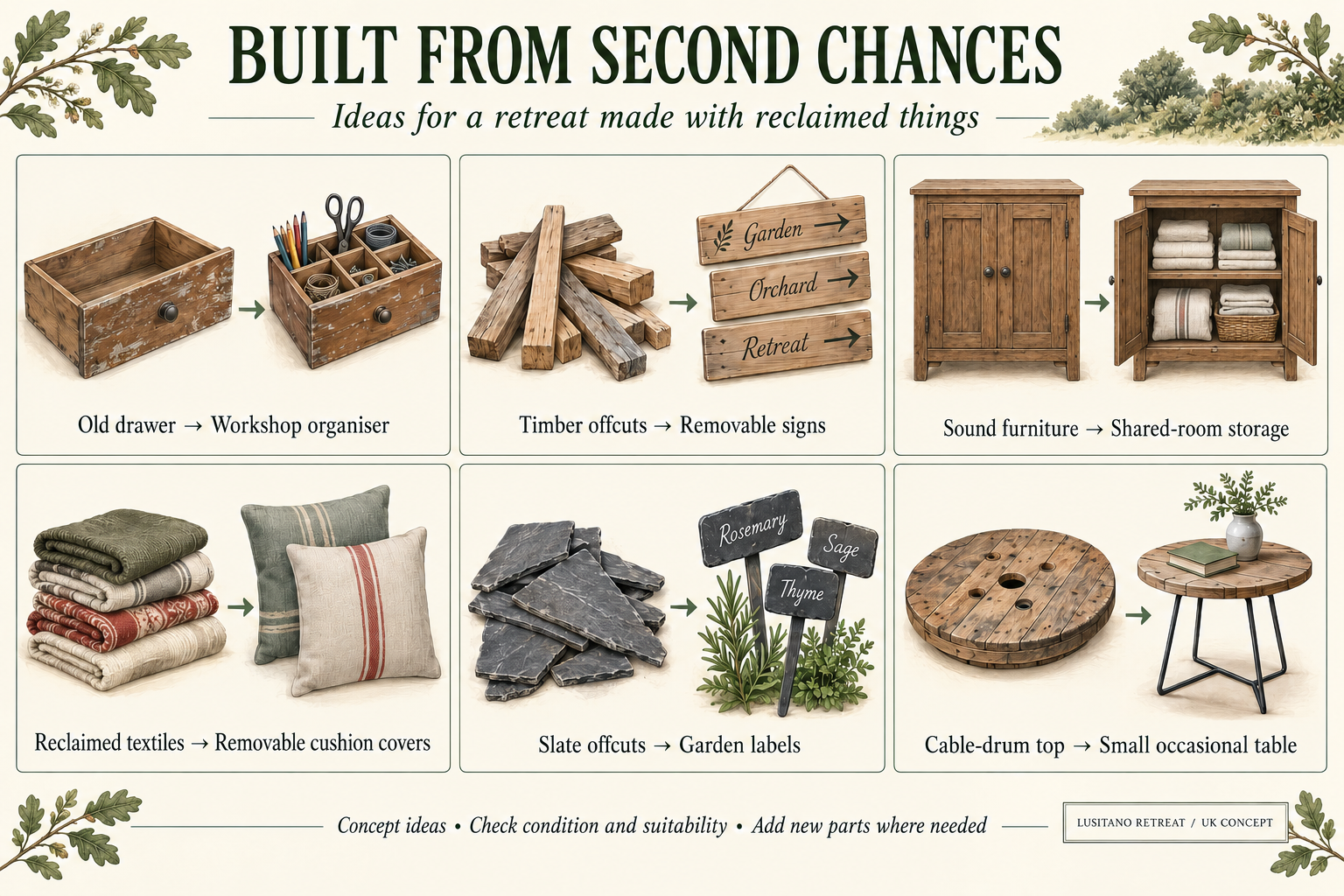
18 concrete possibilities · reclaimed material → useful purpose
A small library of transformations for a workshop, garden and shared countryside space. Each card connects a material with a possible use, the question that comes first and the new parts it may still need. These are concepts to evaluate for an actual property.
18 ideas to explore
Workshop · Idea to assess
Start withA sound reclaimed door panel with a known, suitable finish
ExploreA removable workshop board for mission cards and material notes
The design follows a panel already available, keeping its useful surface in service.
Check the finish and weight, and choose a stable support or appropriate fixing before displaying the panel.
Suitable supports or fixings, card clips and labels.
Source idea: UK concept. UK adaptation remains a concept.
Workshop · Idea to assess
Start withA clean, sound drawer from unwanted furniture
ExploreA tabletop organiser for light, dry workshop items
An intact drawer can be useful without a full furniture makeover.
Check the base and joints, and exclude contamination, sharp fixings or suspect coatings.
Small dividers, labels or a replacement handle if needed.
Source idea: UK concept. UK adaptation remains a concept.
Workshop · Idea to assess
Start withAn existing second-hand cupboard suited to the workspace
ExploreStorage for light workshop supplies in an appropriate dry area
Repairing usable furniture may avoid making a new cabinet.
Check stability, sound shelves and suitable installation, keeping hazardous supplies in purpose-made storage.
Replacement hinges or catches and suitable anti-tip fixings where required.
Source idea: E50. UK adaptation remains a concept.
Workshop · Idea to assess
Start withKnown-source sound timber or plywood offcuts
ExploreA small labelled board for a few lightweight hand tools
Short pieces become useful organisation rather than an imagined building material.
Check splinters, hidden metal and mounting suitability for the actual small load.
Appropriate hooks, fixings and labels.
Source idea: E45. UK adaptation remains a concept.
Workshop · Idea to assess
Start withClean washable fabric from unwanted household textiles
ExploreSimple tool wraps or covers for clean, dry items in storage
Small fabric pieces can serve a practical purpose without entering a building fabric or safety system.
Check cleanliness, fibre condition and snagging, and keep covers away from running tools or charging equipment.
Thread, binding and simple ties where needed.
Source idea: UK concept. UK adaptation remains a concept.
Garden · Idea to assess
Start withSound slate or tile offcuts with manageable edges
ExploreRemovable plant-name markers placed beside containers
Small mineral pieces gain a clear purpose while the planting plan stays flexible.
Select stable pieces without sharp edges and use surface lettering rather than improvised cutting or engraving.
Suitable outdoor marker or paint and a stable holder if needed.
Source idea: E43. UK adaptation remains a concept.
Garden · Idea to assess
Start withA clean second-hand plant container, or a sound bath with known suitable history
ExploreA modest ornamental planting feature, without food-growing claims
An existing vessel can shape a garden idea when its size and condition suit the location.
Confirm provenance, manageable weight, drainage suitability and a stable position before choosing the vessel.
Suitable growing medium and any assessed container accessories.
Source idea: E38. UK adaptation remains a concept.
Garden · Idea to assess
Start withKnown-source untreated sound timber offcuts
ExploreLightweight labels for a small container-garden trial
Even pieces too short for furniture can help record what was planted.
Choose smooth pieces of known history and keep unsuitable finishes out of the growing medium.
Outdoor lettering materials.
Source idea: UK concept. UK adaptation remains a concept.
Garden · Idea to assess
Start withIntact second-hand plant pots and compatible saucers
ExploreA reusable small growing trial that can move with the project
Retaining serviceable pots keeps the first garden manageable and avoids designing around new purchases.
Check previous use, cracks and suitability for the chosen plants, including food-growing suitability where relevant.
Suitable growing medium, labels and any missing saucers.
Source idea: UK concept. UK adaptation remains a concept.
Garden · Idea to assess
Start withAn intact small plant support from an earlier garden
ExploreSupport for an ornamental climbing plant in a suitable container
A serviceable garden item can continue its original job.
Check corrosion, sharp ends, stability and suitability for the eventual plant size and location.
Suitable ties or replacement clips.
Source idea: UK concept. UK adaptation remains a concept.
Shared spaces · Idea to assess
Start withA structurally sound wooden cable reel with known, suitable provenance
ExploreA low side table for a sheltered shared corner
Its existing form can supply a useful surface without a complicated transformation.
Confirm provenance, a suitable finish, stability and freedom from protruding fixings before considering furniture use.
Suitable protective finish and floor pads if needed.
Source idea: E53. UK adaptation remains a concept.
Shared spaces · Idea to assess
Start withAn existing sound second-hand chair
ExploreA repaired chair for an appropriate shared setting
Keeping usable furniture connects the retreat to everyday repair.
Assess joints and stability before use, and seek suitable repair expertise if the chair is unsound.
Compatible replacement fittings or pads where needed.
Source idea: E50. UK adaptation remains a concept.
Shared spaces · Idea to assess
Start withClean durable household fabric suitable for its intended setting
ExploreRemovable covers for existing cushions in a dry shared space
A fresh washable layer can make retained soft furnishings useful.
Check fabric and cushion condition, washability and relevant upholstery/fire suitability for the eventual use.
Thread, closures and new filling only if required and suitable.
Source idea: UK concept. UK adaptation remains a concept.
Shared spaces · Idea to assess
Start withAn existing second-hand coffee table with suitable surface condition
ExploreA repaired surface for books, sketches and conversation
The retained object can carry signs of age without an invented transformation.
Check stability, sharp edges and the suitability of any existing finish for the intended setting.
Compatible repair parts or floor pads as needed.
Source idea: E50. UK adaptation remains a concept.
Story & identity · Idea to assess
Start withClean reclaimed card or paper offcuts
ExploreA removable provenance and repair tag for an inspected object
The story records what is actually known instead of inventing a history.
Remove private information and distinguish documented provenance from an unknown origin.
A pen, suitable string and a protective sleeve if needed.
Source idea: E54. UK adaptation remains a concept.
Story & identity · Idea to assess
Start withA clean reused plain sheet or banner
ExploreA simple backdrop for matched before-and-after object photographs
An existing neutral background makes changes easier to compare.
Check support stability and keep the same framing and lighting notes so the backdrop does not exaggerate the result.
Suitable clips or a safe existing backdrop support.
Source idea: E55. UK adaptation remains a concept.
Story & identity · Idea to assess
Start withKnown-source sound timber offcuts
ExploreA small tabletop project-name sign
The sign demonstrates reuse in the identity itself, without implying a completed site.
Choose smooth suitable material and a stable tabletop format, keeping speculative claims off the sign.
Appropriate lettering materials and a simple stable base if needed.
Source idea: E56. UK adaptation remains a concept.
Story & identity · Idea to assess
Start withA sound known-source board suited to a modest sign
ExploreA removable directional-sign prototype for an assessed route
The sign can be revised as the actual place and its uses become clearer.
Check edges and stable placement, and ensure the wording describes only routes or facilities actually available.
Suitable outdoor lettering and an assessed support if used outdoors.
Source idea: E42. UK adaptation remains a concept.
No ideas match these filters. Clear the filters or try another material.
The wider build / Four ideas to assess for the actual site
The ambition reaches into the buildings, landscape and shared spaces. We would begin with a material and condition survey, then design a suitable first phase around the elements worth retaining. These larger possibilities depend on the actual property, rights, permissions and technical design.
Assess whether an underused barn or outbuilding can keep its fabric and become an appropriate workshop or store. Condition, lawful use, services and repair costs come before choosing the use. A home or guest space needs its own assessment.
Explore suitable reclaimed units for a modest path or courtyard, with a design matched to drainage, stability and access. Existing units need checking; new sub-base or other components may still be required.
Consider known-source reclaimed boards for assessed non-structural wall finishes or furniture. Check condition, contamination, moisture and the intended setting. Structural timber needs a separate competent design and assessment.
Assess repair in place before replacement. Reused components must suit their actual location and required performance, including fire, weather and thermal needs where relevant. The old appearance alone does not establish suitability.
From the original 21-day sprint to a proposed documentary
The original sprint gives the show its structure: observe, choose, try, review and share. The British version follows actual decisions and useful transformations across 21 proposed chapters. It is not a promise to finish a retreat in 21 days.
Series proposal · No episodes are claimed as filmed or released. An actual site and suitable arrangements come before a site-based series.
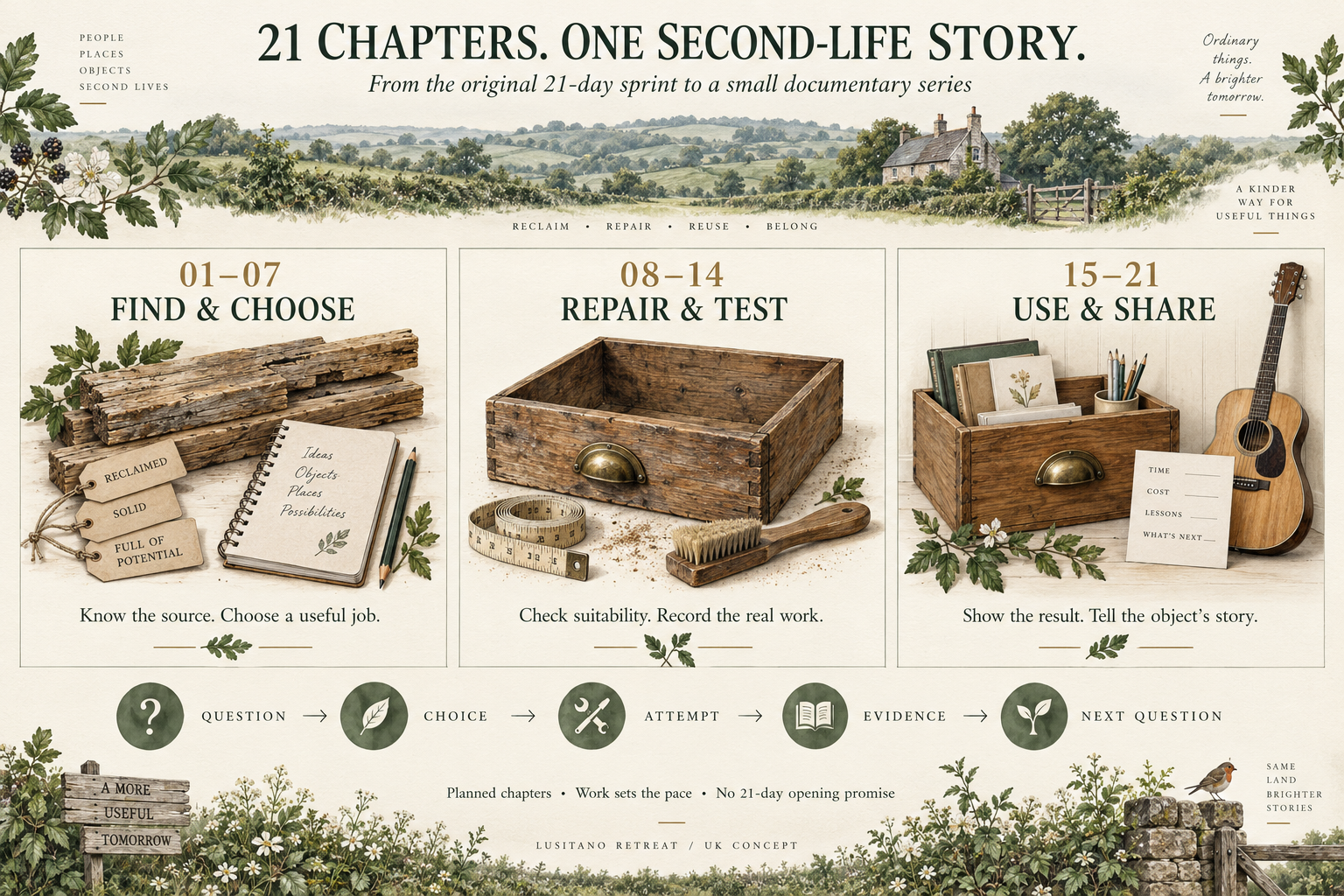
Act 1 · Chapters 1–7
Observe, organise and choose a responsible first phase.
Inventory existing doors, furniture, timber and containers before designing around them; record known provenance and leave unassessed material unallocated.
Reuse angle: A door becomes a planning board.
Reuse angle: A cupboard stays a cupboard; Old fabric protects useful things.
Inspect existing furniture and finishes before deciding what to retain; do not use a cosmetic makeover to conceal damp, unsafe joints or suspect materials.
Sort actual timber offcuts, furniture and small containers by condition and intended use; reject unsuitable items rather than collecting without a purpose.
Reuse an existing paper plan or suitable small board to compare authorised routes; do not turn recovered rubble or timber into an unassessed path.
Review the real salvage inventory against storage space and repair effort; select one manageable item and log what cannot yet be used.
Act 2 · Chapters 8–14
Small repairs, a workable space and a manageable growing experiment.
Reuse angle: A drawer finds a smaller job; A small table keeps its story.
Reuse angle: Offcuts organise small tools.
Consider retaining a sound watering can for an identified garden-water use; unknown tanks, reused treatment equipment and plumbing are not default reuse projects.
Observe how existing outdoor furniture and container materials behave in weather; record deterioration before deciding on reuse or replacement.
Reuse angle: Slate names the growing trial; A spare tub holds ornamental colour; Existing pots return to growing.
Retain a suitable existing compost container where its condition and intended method allow; do not treat contaminated timber, painted scraps or unknown waste as garden inputs.
Reuse angle: Short timber becomes plant labels; A light support gets another season; Old cloth frames the honest reveal.
Act 3 · Chapters 15–21
Quiet shared space, honest resource records and creative storytelling.
Reuse angle: A sound cable reel becomes a table; A chair earns its place.
Reuse angle: Clean textiles become washable covers.
Retain a serviceable bag or notebook for documenting an authorised walking route; reused tyres, posts and scrap metal do not become exercise equipment by default.
Reuse angle: A leftover board points the way.
Count retained tools, borrowed equipment and essential new components honestly; electrical batteries, wiring and fixed energy systems need their own competent assessment.
Reuse angle: Scrap card tells the object story; Offcuts carry the project name.
Review which actual objects and materials earned a useful second life, what new parts were required and what remains unsuitable; do not claim an unmeasured recycled-content percentage.
A useful episode starts with a real question and ends with something we can show: a decision, a measured change, a repair, or a reason to pause.
Explore the proposed pilot →Your own small piece of research
Capture what you know before deciding what to make. Fill this in for one object or material, download your notes, or print a sheet to take to a supplier or workshop.
Your notes stay on this page and are not sent to us or saved automatically. Download or print them before leaving. This is your personal research sheet, rather than the project’s shared task list or an approval record.
From a good idea to a useful question
Our fieldnotes and concept libraries bring the original research into the UK chapter. They help frame the next questions; a particular material, building or installation still needs an assessment that fits its actual use.
Start with permission to obtain the item and a record of its source. A second-hand product and a waste material can require different treatment; check the actual circumstances before collecting or processing material.
General guidance, checked 11 October 2026. The idea cards are design proposals, not technical specifications or approvals for individual materials.