
01 / The research
Draw the services before choosing the cabin position
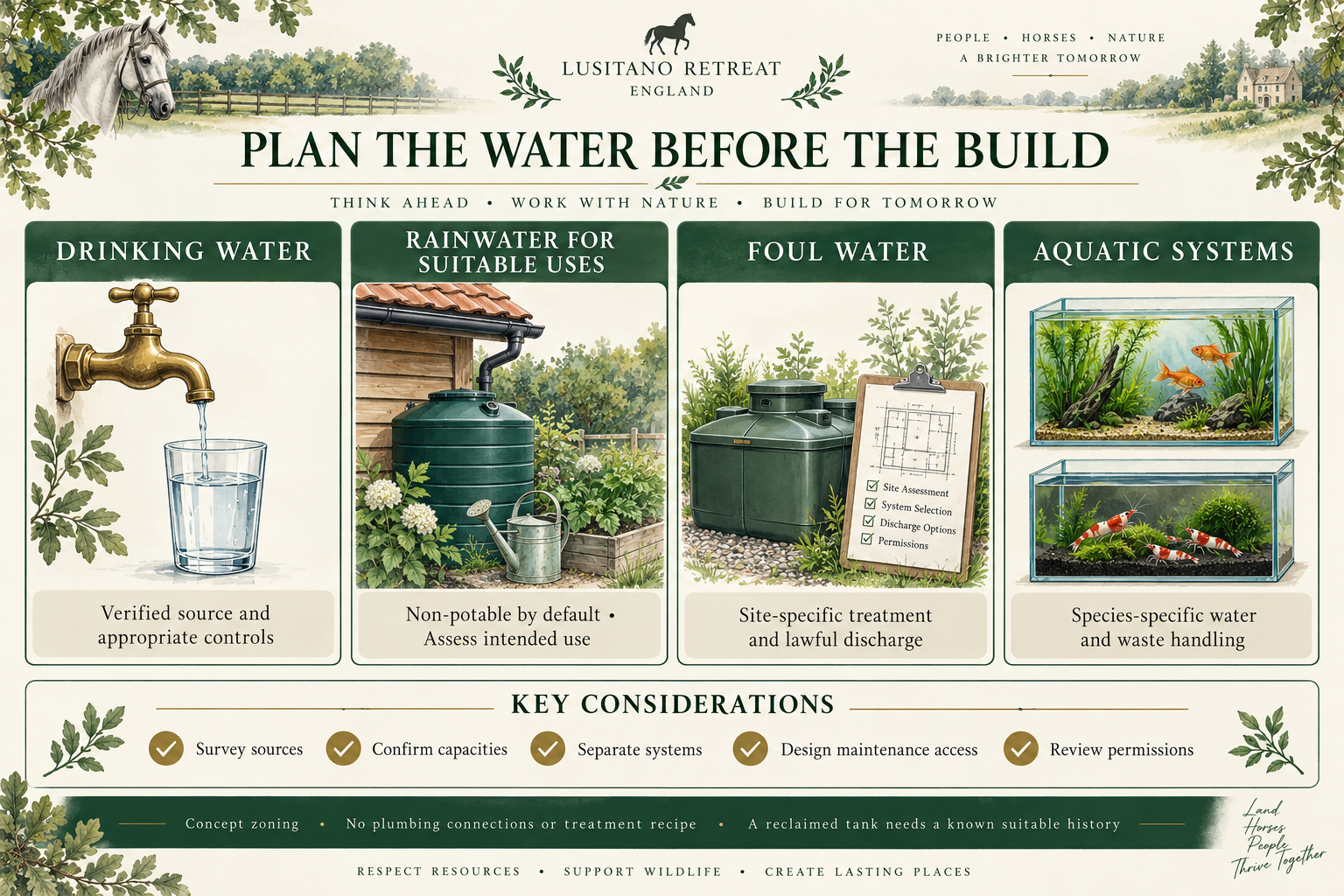
A retreat needs a workable route for every water stream before its buildings acquire a final position. Our proposed English site remains unselected. The first drawing should identify drinking water, non-potable rainwater, foul sewage and any future aquatic system separately. Add the existing supply point, possible treatment area, maintenance access and neighbouring water features. This is a survey brief, not a pipe-connection diagram.
Estimate occupancy, operating days and peak demand with the designer. Include showers, toilets, kitchen use and cleaning rather than counting beds alone. A sauna or fish system may introduce different demand patterns. Record what is measured, what the owner reports and what remains unknown; a tap producing water during one viewing does not establish summer capacity or drinking-water quality.
02 / The research
Establish a reliable drinking-water route
Compare a confirmed mains connection with an existing private supply using actual records and supplier advice. For mains water, establish ownership, connection rights, capacity and charges. For a spring, borehole or shared network, ask the local authority about classification, risk assessment and monitoring. DWI identifies commercial supplies separately, and its Regulation 9 guidance includes holiday accommodation. Small guest numbers do not automatically make a commercial supply domestic. [W1] [W2]
Obtain source information, recent sampling records, treatment details and maintenance history. Ask who responds when a result fails or the supply stops. The commissioning plan should specify evidence required before guest use and a practical contingency. A previous household test cannot be assumed to cover a larger visitor operation.
03 / The research
Give rainwater a defined, separate job
Rainwater could serve a specifically assessed non-potable use, subject to the collection surface, storage condition, exposure and distribution design. Roof runoff can carry debris and contaminants; a mesh screen does not establish water quality. Identify which outlets guests can reach and how misuse will be prevented. Labels help communicate intended use but do not replace a correctly designed system.
Keep the proposed network identifiable and obtain qualified advice on separation and backflow protection, including any mains top-up arrangement. The regulator-approved water-fittings specifications address backflow. DWI also explains that rainwater and recycled water fall within private-supply rules where supplied for the specified domestic, food-production or consumption purposes. Calling a tank recycled does not create a regulatory exemption. [W3] [W4]
04 / The research
Inspect reused tanks before assigning any service
A recovered tank needs a traceable previous use, material identification and condition assessment. Record its former contents, cleaning records, lid integrity, fittings and storage history. Reject unknown-history containers for drinking-water service. A seller saying food grade, a clean appearance or an IBC label does not prove suitability after previous use; the whole water-contact system needs assessment.
Reuse may make better sense for an assessed non-potable application, but contamination, leakage and access still matter. Do not repurpose a suspect chemical container by relying on a home cleaning recipe. Storage needs a secure cover and a maintenance plan. DWI highlights covered storage, suitable fittings and distribution inspection as parts of controlling water-quality risks. [W9]
05 / The research
Resolve foul drainage as its own project
Find out where each existing toilet and sink actually drains. Request drawings, ownership details, discharge records, servicing and emptying history. Establish whether a public sewer connection is available and what alternatives can lawfully serve the proposed use. An existing tank on a farm is not evidence that it has spare capacity or an appropriate discharge route.
England’s general binding rules distinguish qualifying small discharges to ground from discharges to surface water. Both contain conditions beyond volume, and an environmental permit may be necessary. A septic tank cannot simply discharge directly to a stream under those rules. Have the designer assess the actual site, receiving environment, treatment specification and applicable requirements. Being off-grid does not establish permission. [W6] [W7]
06 / The research
Keep future fish and shrimp systems distinct
Aquaculture adds a separate process-water question. Establish source quality, make-up demand, salinity, solids, cleaning waste and intended discharge before selecting equipment or livestock. A freshwater growing system and a brackish shrimp proposal cannot share assumptions about disposal. Recirculation reduces some flows but does not prove there will be no effluent.
Ask the Environment Agency and the relevant specialist about the actual discharge route and any permit or sewer-consent requirements. Do not send saline or process waste into a domestic sewage system without an assessed agreement and compatible design. Water-discharge guidance covers liquid effluent and wastewater; the separate aquatic guide addresses animal-health registration and authorisation. [W8]
07 / The research
Take a service survey brief to each possible site
Walk the service routes with the owner and a competent designer. Locate supply assets, drains, outfalls, inspection covers and areas needed for maintenance vehicles. Record slopes, flooding history, seasonal limitations and any neighbouring rights. Proposed locations must follow site-specific assessment rather than a universal distance copied from another project.
For any abstraction proposal, establish the source and combined quantities involved. EA guidance says taking more than 20 cubic metres a day is likely to require a licence, with conditions and exceptions needing review; dividing demand between tanks is not a shortcut. Ask for a written account of permissions, capacity evidence and unresolved surveys before purchasing infrastructure. [W5]
08 / The research
Price the whole service and assign its upkeep
Compare quotations covering surveys, consent work, connection or treatment equipment, civil works, commissioning and ongoing maintenance. Add sampling, energy, consumables, emptying, inspections and repair access where applicable. Keep unpriced items visible and separate capital costs from recurring costs; a free recovered tank can still require substantial assessment and replacement fittings.
Before operation, create a simple asset map and named responsibility for inspections, records, faults and emergency response. Include seasonal shutdown and restart advice from the system supplier. Film the survey, decisions and commissioning evidence as honest show chapters. The 21-day format records progress; it does not promise that a water system or its permissions can be completed in 21 days.