
01 / The research
Start with an equipment and operating inventory
A cabin, workshop and sauna create different electricity demands. Before choosing panels or batteries, list each proposed appliance, its labelled input, operating hours, season and whether it must continue during an interruption. Include lighting, refrigeration, water pumps, ventilation, cleaning equipment and any future aquatic circulation. Leave unselected equipment as unknown rather than borrowing ratings from a similar-looking product.
For our proposed retreat, this inventory is a design brief: no site or supply has been approved. Record measured consumption separately from a manufacturer rating and an assumption. Ask the electrician to review the intended uses, wet areas, outdoor equipment and guest access. HSE recommends competent electrical advice and specialist engineering input where necessary. [E1]
02 / The research
Separate simultaneous power from daily energy
Power describes demand at a moment; energy describes consumption over time. A daily total alone cannot establish whether a supply can operate a sauna heater while cooking, heating water and using workshop equipment. Prepare a timetable showing plausible overlaps, including busy changeover days and cold-weather use. Ask the designer to assess starting behaviour and other characteristics of the actual equipment.
For a steady load, power multiplied by operating time gives an energy estimate, but thermostatic cycling, standby demand and losses need explicit treatment. These are planning calculations, not electrical sizing instructions. Keep peak demand, daily consumption and essential continuity requirements in separate columns. Review these figures whenever the intended occupancy or equipment changes; a staged build still needs a coherent final-load assessment.
03 / The research
Establish what the existing connection can actually provide
Ask the landowner for supply records, existing installation information and any connection agreements. Identify the responsible distribution network operator and obtain a competent assessment of available capacity. A working socket in an outbuilding does not establish a suitable supply for several cabins or a sauna. Resolve supply ownership, cable routes, access rights and proposed expansion before fixing building locations.
UK Power Networks explains that combinations of importing and exporting technologies require assessment and sometimes a supply upgrade. Its guidance illustrates the process; the actual site may have a different network operator and a different application route. Obtain the applicable requirements from that operator, including any approval or notification needed for generation, storage and export. [E2]
04 / The research
Design caravan, outdoor and sauna installations for their actual use
Give the electrician the caravan model, alteration plans, intended stationary or movable use, service routes and sauna manufacturer documentation. A cabin-style enclosure can change access, exposure and the practical arrangement of services. The installation designer must assess the whole system and its protective arrangements, inspection, testing and maintenance; this guide provides no wiring diagram or connection recipe.
Construction supplies also deserve their own plan while work proceeds. HSE construction guidance addresses temporary electrical systems and the need for competent inspection and testing. Agree how tools will be supplied and how equipment will be protected from the working environment. Completion of a temporary setup does not approve the finished guest installation. [E3]
05 / The research
Assess solar against the actual site and winter operation
Solar output depends on the location, available sunlight, orientation and shading. Survey trees, neighbouring structures and proposed roof or ground positions before requesting a design. A caravan roof or independent enclosure needs its own structural and weathering assessment; an attractive panel layout is not evidence that the supporting structure can carry it. Energy Saving Trust identifies shading and roof suitability as material considerations. [E4]
Request seasonal production estimates and compare them with the operating inventory. An annual generation total can conceal difficult winter periods when heating or lighting demand differs from summer use. Keep predicted output, measured output and the electricity actually available to essential services distinct. Do not present a summer demonstration as proof of year-round independence.
06 / The research
Treat batteries and backup as separate design decisions
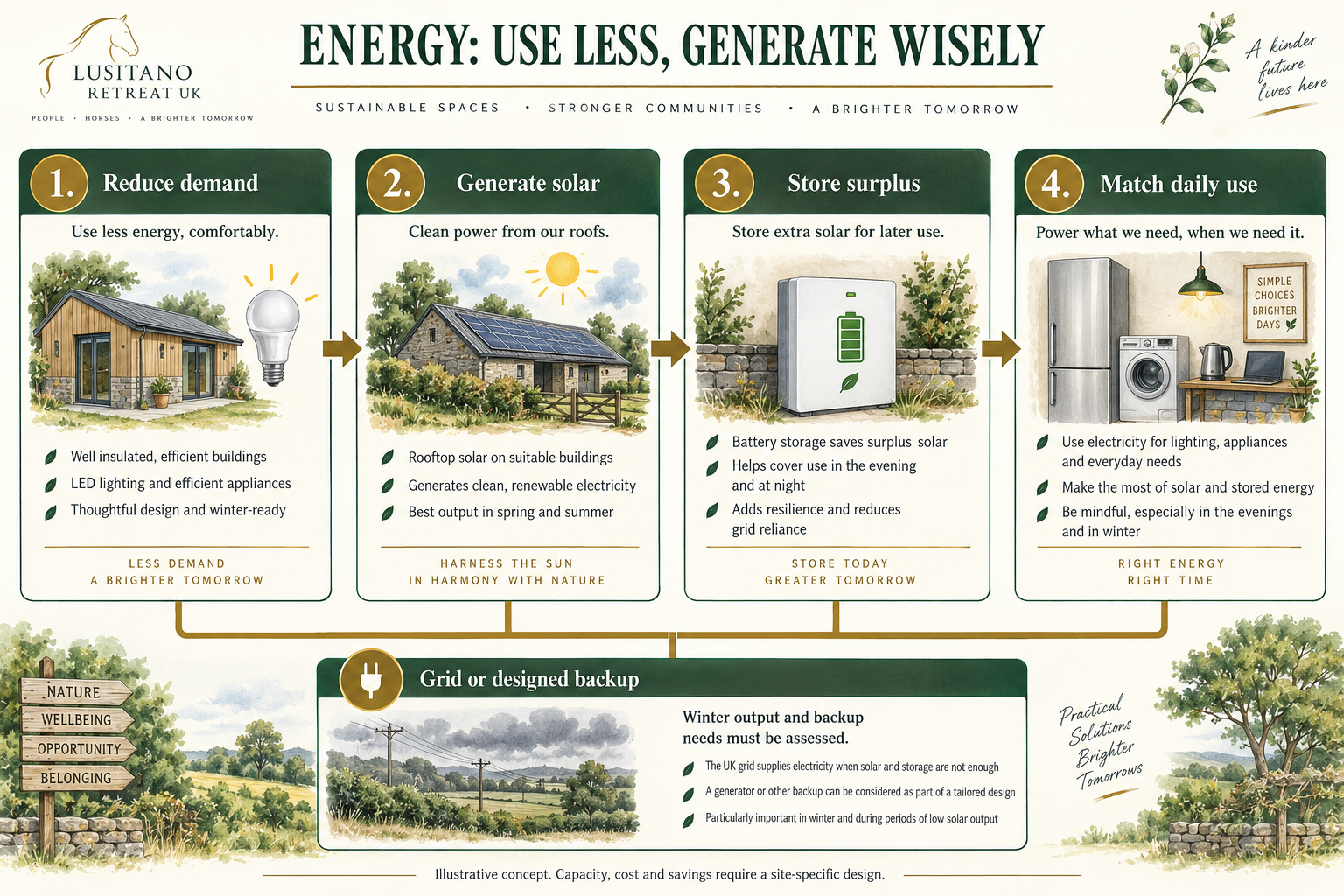
A battery stores electricity; it does not generate it. Its useful capacity, delivery limits, losses and compatible controls matter alongside the way it will be charged. Energy Saving Trust describes storage as a way to shift electricity between generation and use. Request a design that explains what happens during an interruption rather than assuming any battery automatically powers the whole site. [E5]
Define essential loads and tolerable downtime, then have the specialist compare suitable continuity options. Future fish systems may need a different response from guest lighting. Off-grid proposals require an explicit seasonal generation, storage and backup strategy. Energy Saving Trust discusses these as interacting elements; the appropriate combination remains site-specific. [E6]
07 / The research
Apply the recovery principle carefully to energy equipment
Reclaimed timber may provide an assessed external screen, but electrical equipment needs identifiable specifications and a defensible history. For used panels, request identification, condition records and suitable testing. For batteries, require known provenance, condition and compatibility assessment by an appropriate specialist. Apparent cleanliness or a low purchase price cannot establish electrical or fire suitability.
Our project rule is to avoid improvised repurposed battery packs and mixed components assembled from unknown sources. Ask the designer to specify compatible equipment, suitable location, access, isolation and maintenance arrangements. This is a procurement requirement for professional assessment, not a statement that all second-hand equipment is prohibited. Reserve the reuse budget until the complete proposed system has been reviewed.
08 / The research
Close the permission and commissioning questions before guest use
Confirm planning, building-control and fire requirements for the actual land, building classification and equipment. Do not transfer household solar assumptions automatically to a farm retreat or treat concealed caravan running gear as proof of an exemption. Approved Document P addresses electrical safety in dwellings; a competent adviser must establish whether and how its scope applies to the proposed works. [E7]
Collect the agreed design, relevant approvals, equipment documentation, inspection and test evidence, operating instructions and maintenance responsibilities. Record unresolved items before commissioning rather than treating delivered equipment as an operational system. For the show, film the inventory, site assessment, specialist design and verified handover as distinct stages. The 21-chapter structure documents decisions and progress; it does not promise completion of infrastructure within 21 days.