
01 / The research
Mission P0-01: give the drawer a useful job
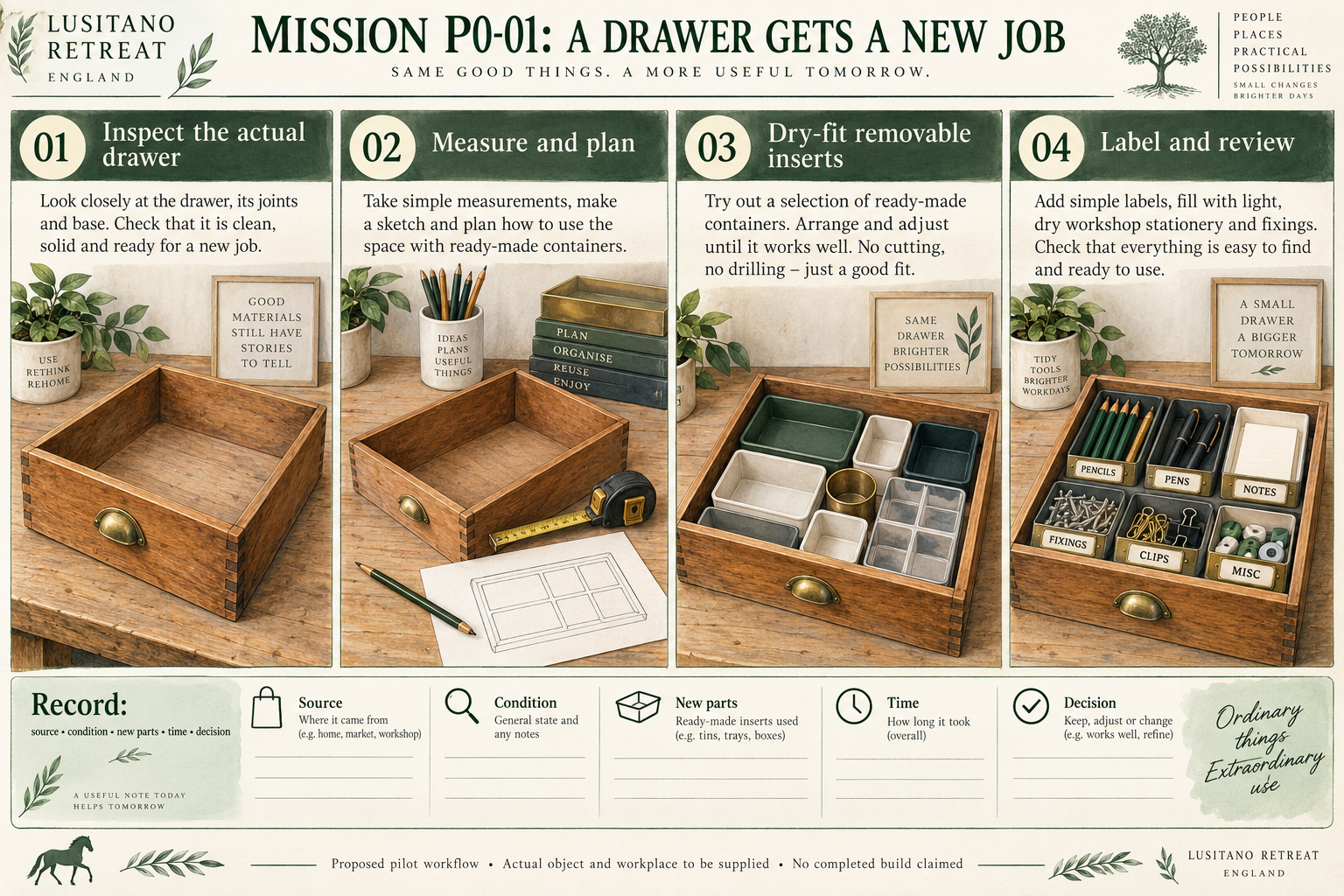
The proposed result is a drawer standing securely on a suitable worktop, holding selected light, dry items such as pencils, clips and a measuring tape. Preserve the sound body and choose the layout around the items that actually need a home. This is an editorial workflow proposal, to be adapted after inspection.
The first story in Before the First Nail asks whether one discarded object can become useful again. Record the answer honestly: ready for this use, further assessment needed, or unsuitable. A decision to stop can complete the assessment stage without claiming that an organiser has been built.
02 / The research
Start with the owner’s missing information
Leave provenance, condition and workplace blank until the owner supplies them. Appearance alone cannot establish the wood species, previous contents, coating or treatment. Give the drawer an identifier and photograph its whole body, underside, corners, handle and any marks before changing anything.
Record the actual inspection and work dates separately. Confirm permission to work and film at the chosen place; keep personal paperwork and private details out of view. The record should travel with the project so that later captions describe evidence rather than an invented history.
- Drawer identifier and known previous use: to be completed.
- Condition of base, sides, joints, handle and surfaces: to be completed.
- Workplace, filming arrangement and inspection date: to be completed.
- Internal length, width and usable depth: measure the actual drawer.
03 / The research
Inspect before choosing tools or cleaning products
Look for a loose or damaged base, opening joints, protruding fasteners, sharp edges, dampness and suspect deposits. Check that the drawer can sit steadily on the intended worktop. Do not pull a questionable handle or perform a loading experiment to prove a damaged joint is strong enough.
If the material, coating or contamination is uncertain, pause and obtain an appropriate assessment. Choose cleaning only after establishing what the surface can tolerate and follow the product instructions. Unknown coatings are not a reason to start sanding. HSE explains that wood dust can harm health and that dusty woodworking needs suitable controls. [D1]
04 / The research
Measure a removable layout before making parts
Arrange the chosen contents on paper first, then trial suitable ready-made small containers inside the accepted drawer. Measure the narrowest usable space, including any taper, corner blocks and screw ends. Allow room to lift each item out and remove a container for cleaning; do not force a tight divider against weak sides.
A removable insert is the preferred first version. Use sound, suitable material with a known history, or appropriate existing containers. Sketch each compartment and label its purpose. If cutting becomes necessary, plan that task separately with suitable material, tools and controls; a saw is not a required prop for this mission.
05 / The research
Make only the changes the object needs
After acceptance, clean as appropriate and carry out only a justified minor repair. Dry-fit removable containers or dividers and add clear labels. Manual assembly can be sufficient. If a fixing is genuinely needed, select it for the actual material and thickness, checking that its tip cannot project through the base or sides; no universal screw length is specified.
Keep a serviceable finish where possible. A new finish requires a known compatible surface, suitable product and its stated preparation and curing conditions. Do not add stripping, power sanding or a decorative coating simply to create a transformation for the camera. The intended setting remains a dry desktop, without wall mounting, drawer runners or heavy storage.
06 / The research
Bill of materials: categories to fill after inspection
The smallest useful version may need only the accepted drawer, existing containers and labels. Keep quantities, purchases and actual costs separate. An unknown amount remains blank rather than becoming zero, and time spent assessing, cleaning and tidying belongs in the record.
| Category | Decide from the actual object |
|---|---|
| Existing drawer | Identity, condition decision and elements retained |
| Layout | Removable containers or suitable divider material; measured quantities |
| Cleaning or repair | Only compatible products and justified parts |
| Fixings and finish | Only if needed; material suitability and instructions |
| Documentation | Labels, pencil, measuring tape, camera support and notes |
| Actual record | New and reclaimed parts, receipts, time and unresolved work |
07 / The research
Check everyday usefulness and record the outcome
On the chosen worktop, check ordinary placement and retrieval of the selected light items. Confirm the organiser sits steadily, does not snag hands and can be cleaned without forcing its parts. This is a functional check for the chosen use, not a structural test, load rating or approval for heavier contents.
Repeat the original camera position for the comparison. Record what was retained and added, actual expense, elapsed work time and anything unresolved. Mark ready only when suitability and ordinary use have been checked. Otherwise record the specific question or reason for rejecting this application and the next assessment step.
08 / The research
The pilot: 14 planned shots, one honest result
The existing P0-01 mission and shot list guide a proposed episode of about seven and a half minutes. That duration is an editing outline, not recorded footage or a build deadline. Shoot landscape 16:9 with the main action near the centre, keep the comparison framing consistent, and record speech separately from work needing attention.
Use real room sound and actual handling sounds. Another Useful Day remains a musical proposal, not a supplied audio master. The mission connects chapters 8, 9 and 20 of the 21-chapter show; the series structure does not promise a completed retreat in 21 days.
| Shot | Planned evidence |
|---|---|
| 01 | Whole drawer before work; record camera position |
| 02 | Handle, joint and base details |
| 03 | Presenter or voiceover explains the proposed job |
| 04 | Mission card with unknown fields left open |
| 05 | Actual condition inspection |
| 06 | Write the suitability decision |
| 07 | Measure the interior and draw the layout |
| 08 | Trial the chosen contents and removable inserts |
| 09 | Appropriate preparation or minor repair, only if justified |
| 10 | Labels and organised light contents, if completed |
| 11 | Notebook links drawer, workshop and retreat concept |
| 12 | Ordinary retrieval and matching result shot, if accepted |
| 13 | Record retained parts, additions, time and actual expense |
| 14 | Truthful conclusion, next question and project address |