
01 / The research
Cost the whole usable project
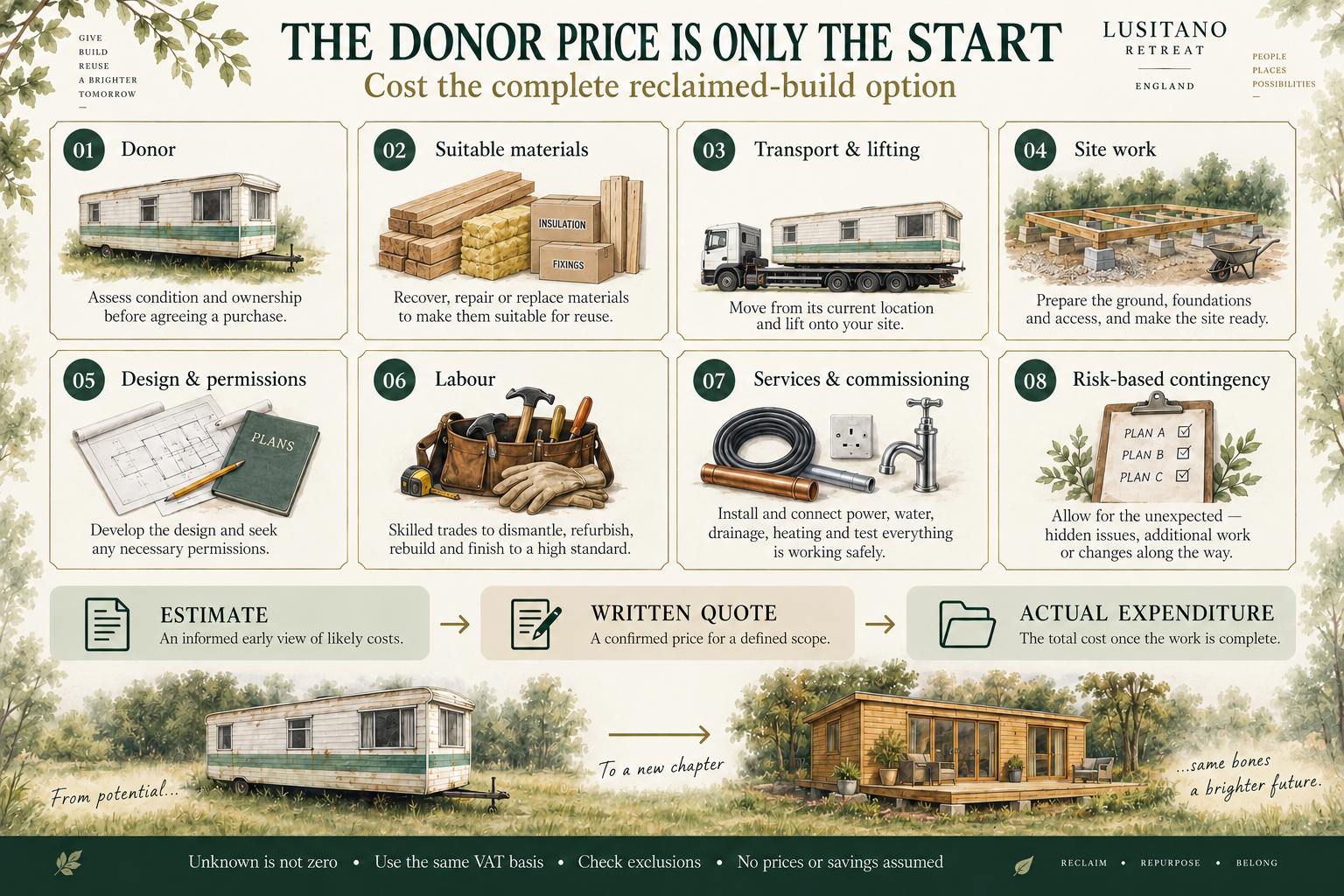
A donor caravan’s asking price buys a starting point. A usable retreat cabin also needs assessment, a viable location, an agreed design, delivery, construction, services and acceptance checks. Start with a written brief covering intended use, people, seasons, finish and maintenance. Keep optional sauna and growing systems as separate packages until their interfaces are understood.
Draw the boundary of each package. Record what is included, excluded and supplied by someone else. Distinguish the caravan itself from its surrounding timber enclosure, access, drainage and service connections. An attractive exterior concept does not establish the supporting design or the cost of bringing the complete proposal into use.
02 / The research
Give every amount an evidence status
Use three distinct columns: estimated, quoted and actual. An estimate is a working allowance with a stated basis; a quote is a supplier’s dated offer for a defined scope; an actual is a recorded cost supported by an invoice or receipt. Preserve earlier versions so changes remain explainable.
Unknown is a status, not a zero. Keep an unresolved transport or electrical item visibly open and show the known subtotal separately. Record currency and whether VAT is included, excluded or unknown for each line. Do not apply an assumed VAT rate across mixed purchases, labour and services. A total with unresolved items remains provisional.
03 / The research
Inspect the donor and its journey
Treat purchase, condition survey, removal and delivery as separate lines. The survey should inform repair allowances before appearance drives the decision. Record which findings are evidenced, which need specialist assessment and which could change the proposal substantially. Seller descriptions and photographs help screening but cannot establish the condition of hidden structure.
Transport comparisons need the same origin, destination and access information. Include dismantling or preparation, loading, lifting, route assessment, delivery positioning and any reinstatement within the requested scope. Identify responsibility for each handover. Where a destination is undecided, record a transport scenario and its assumptions rather than presenting it as a firm delivery price.
04 / The research
Measure the real cost of reclaimed material
Reclaimed boards may arrive cheaply but still need collection, unloading, sorting, storage, cleaning and assessment. Estimate quantities from the proposed design and distinguish collected quantity from usable yield. Record rejects and their handling separately. Free acquisition does not make preparation labour, vehicle time or storage free.
Keep new critical components in their own package: suitable fixings, membranes, weathering details and specified service components. Reuse decisions follow the assessed application. Compare buying prepared material with preparing salvage using the same usable quantity and finish. Include tools or equipment hire attributable to preparation, without charging the whole project for equipment already allocated elsewhere.
05 / The research
Separate design, site work and labour
Allow for measured surveys, design development and the reviews needed for the chosen proposal. Keep unresolved professional work visible. Break construction into enabling work, supports, enclosure, openings, roof weathering and finishes. Site preparation and access can change independently of the donor’s purchase price.
Record labour as tasks with an estimated duration and an explicit basis for paid or owner time. Owner labour may have no cash payment, but its hours still affect scheduling and the practicality of the plan. List specialist trades, hire periods, deliveries and supervision. Avoid counting installation twice when a supplier’s package already includes it.
06 / The research
Compare offers by scope and conditions
Ask suppliers to respond to one version of the brief. Compare scope, exclusions, quantities, materials, delivery, installation, tests, payment stages, validity and responsibility for defects. Record the date and the assumptions behind each response. Resolve gaps before choosing the lowest headline figure.
Use a comparison table with one row per work package and one column per offer. Mark an omitted item as unresolved rather than included. Separate alternatives from the base scope. Keep VAT treatment explicit, and ask the supplier to clarify ambiguity. A quote for a shell and a quote for a commissioned installation describe different purchases.
07 / The research
Include commissioning and ongoing care
Create separate lines for water, drainage, electricity and any other selected system, including connections and interfaces. Record the assessment, installation, testing and handover work within each package. Keep sauna and aquatic systems independently costed, including the service capacity they would require.
Plan for cleaning, inspection, consumables, maintenance and eventual replacement as a separate operating view. Estimate these from the chosen equipment and expected use, with uncertainties shown. They are not evidence of visitor demand or income. Keep commissioning records and instructions with the asset register so the first build decision also supports later care.
08 / The research
Use uncertainty to sequence the project
Build contingency from identified uncertainties: hidden damage, unusable salvage, access changes or unresolved service work. State which items each allowance covers and avoid duplicating allowances already embedded in estimates. There is no universal contingency percentage in this framework; the basis should change as evidence improves.
Review the register at decision points: before a deposit, before transport, before committing to the enclosure and before commissioning. Update estimates from findings and quotes, explain variances and record actuals without overwriting their history. The next useful spend is often the assessment that resolves a major unknown. The resulting register supports a decision; it does not certify affordability or promise a return.