
01 / The research
Start with the pond we actually want
The earlier Lusitano concept already included a natural pond alongside food growing, rainwater and a separate aquaponics module. The useful ambition survives: a beautiful living water feature that supports wildlife and makes the retreat landscape more resilient. The earlier Portuguese notes are concept history, however, rather than a survey or permission for an English site. We have not established a parcel, existing pond condition, catchment, soil profile, water source, dimensions or operating budget for this build.
For the first design brief, choose a fish-free wildlife pond as the baseline and examine water storage as a separately quantified function. If reliable irrigation storage is essential, compare a dedicated tank or separate storage pond with drawing down the wildlife pond. If swimming is essential, commission a purpose-designed swimming facility. Giving one basin all three jobs without resolving their conflicts is a poor starting point. Our proposed sequence is observation, alternatives, approvals, detailed design, construction, establishment and evidence-based care.
This guide is a decision and construction workflow for England, with sources reviewed on 14 October 2026. It is not a dimensioned earthworks design. A drawing cannot establish safe slopes, groundwater conditions, a legal outlet or bathing-water quality. The eventual designer should replace each unknown with measured evidence and specify what the operator must do when the system behaves differently from the prediction.
02 / The research
What “self-cleaning” can honestly mean
A living pond can recycle organic matter through microorganisms, invertebrates and plants. Sediment settles, plants take up nutrients while growing, and the ecosystem changes through the seasons. None of those processes makes pollution disappear on demand. A useful project target is a low-intervention pond with controlled nutrient inputs and a manageable maintenance plan, rather than sterile water, permanent visual clarity or zero work.
The balance sheet matters: incoming nutrients and sediment must be limited, retained or eventually removed. A plant that dies and decomposes in the basin can return nutrients to the water. Collecting excessive cut growth or sediment is a management decision, not proof that the ecology failed. Record interventions so that the next season teaches us something instead of repeating the same cosmetic treatment.
Use separate success measures: habitat variety, safe access, water-level behaviour, plant establishment, evidence of pollution and maintenance effort. Clear water alone is not a health certificate. A newly filled pond may look different from an established one; do not promise a fixed number of days until it becomes balanced. Observation and appropriate testing should answer a specific question, rather than generate impressive-looking numbers without an agreed response.
03 / The research
Compare four water systems before combining anything
The distinction is practical. A wildlife pond benefits from habitat and a natural seasonal cycle. A storage system needs a dependable usable reserve and an operating drawdown limit. A fish-production system adds feed, animal welfare, waste and equipment dependencies. A swimming facility adds deliberate human exposure and an operator management regime. A planted edge is compatible with several designs but does not make the designs interchangeable.
HSE distinguishes maintained swimming facilities from open water not maintained as a swimming facility. Do not infer that calling a commercial guest facility a pond removes swimming-operation responsibilities. A swimming proposal needs specialist assessment of its actual use, supervision, access, rescue arrangements, treatment and water-quality management. This guide does not set a regeneration-area ratio or certify a natural swimming pool. [P11]
The current fish and shrimp guide remains the place to investigate aquatic production. Keep fish stock, production water and associated equipment separate from the wildlife concept until the relevant specialist has reviewed biosecurity, welfare, movements, drainage and permissions. There is no proposal here to connect a fish tank overflow, sauna drainage or sewage treatment bed to the wildlife pond.
| Primary job | Design priority | Question to resolve |
|---|---|---|
| Wildlife habitat | Clean inputs and varied margins | Can it follow a seasonal cycle without routine stocking? |
| Irrigation reserve | Usable storage through the dry period | What remains after demand, losses and ecological reserve? |
| Natural swimming facility | Managed human exposure | Who designs, tests, operates and closes it when needed? |
| Fish or shrimp production | Species-specific welfare and biosecurity | What independent system and permissions are required? |
04 / The research
Build a site evidence pack before hiring the digger
Walk the candidate area from authorised, safe positions in contrasting weather. Mark roof drainage, field runoff, ditches, springs, low spots, neighbouring boundaries and existing water features. Record the difference between a visible ditch and a confirmed legal drainage route. Locate underground services using the appropriate records and competent survey; a clear lawn is not evidence that excavation is safe.
Commission soil and ground assessment appropriate to the scale. The designer needs to understand soil permeability, available clay, bedrock, contamination, groundwater and the consequences of changing levels. An exploratory excavation is itself work requiring service checks and safe excavation arrangements. Do not enter unsupported test pits, excavate beside structures or improvise a trial dam for the camera.
An existing pond is not an empty construction site. Establish its ecological value before deepening, draining, moving plants or modifying banks. Protected species can affect both the work and surrounding habitat. Natural England guidance explains great crested newt protection and licensing; obtain competent ecological advice early enough to accommodate survey seasons. A quick visual check without seeing an animal does not establish absence. [P8]
- Parcel plan, ownership and permission to investigate; easements and maintenance access.
- Dated photographs, ground levels, existing drainage and seasonal water-level observations.
- Soil and groundwater findings, service survey and contamination history.
- Ecology assessment, protected-site constraints and invasive-species check.
- Intended visitors, children, dogs, livestock, maintenance staff and proposed water uses.
- Written list of unanswered questions, with the person responsible for resolving each one.
05 / The research
Calculate the water balance, including the bad month
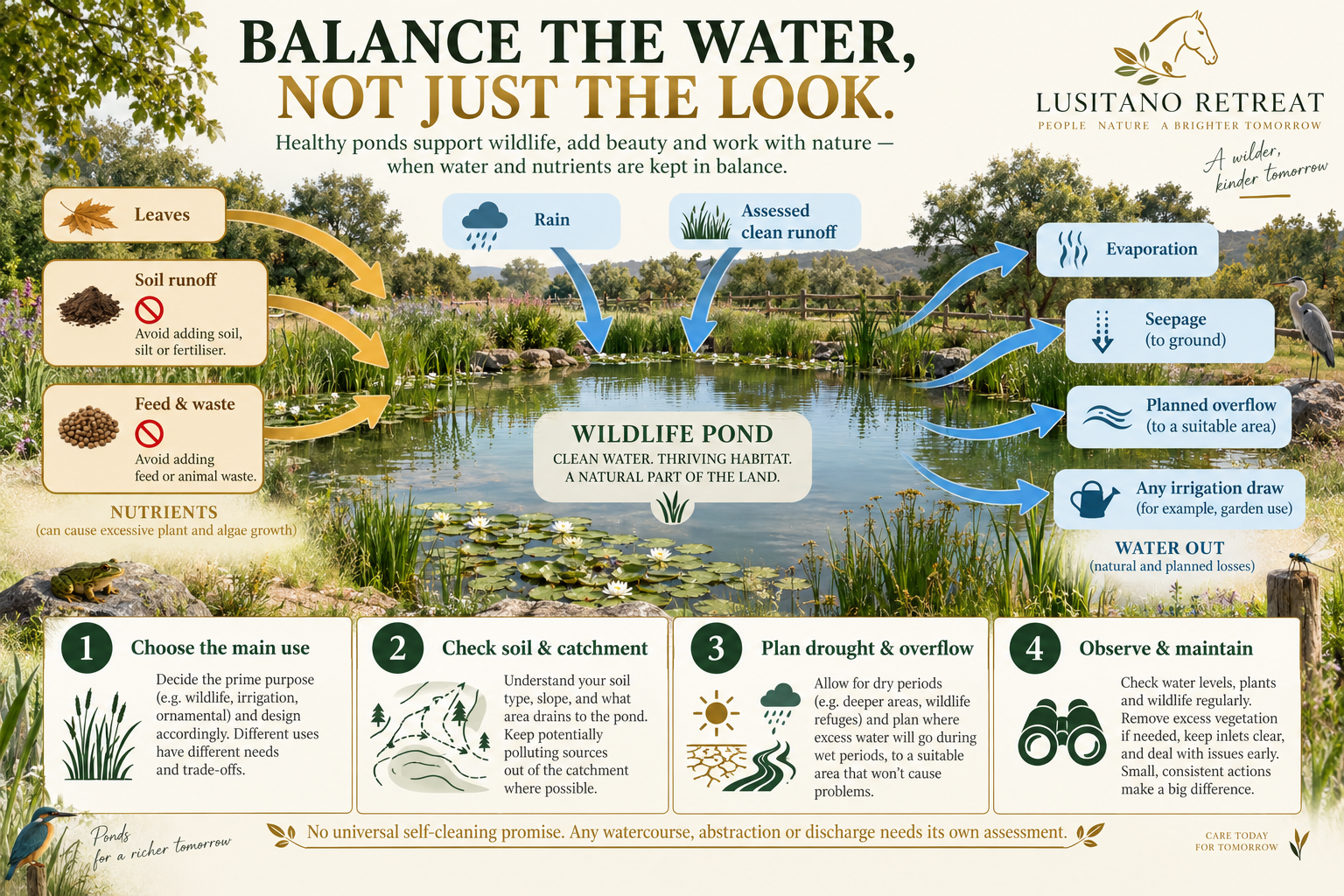
Prepare a monthly working model: change in stored water equals inflow minus evaporation, seepage, overflow and deliberate withdrawal. Direct rainfall depends on the changing pond surface. Roof collection depends on roof area, rainfall, collection efficiency and losses. Runoff from surrounding land varies with soil, saturation and land management. These are different inputs and should not be combined into a single optimistic rainfall figure.
As a dimensional example only, 10 millimetres of rain falling directly on 100 square metres represents one cubic metre of water before losses or overflow. It is not a forecast for this site. A usable storage estimate needs basin levels and a volume curve, not simply maximum depth multiplied by the area of an irregular outline. Ask the designer to identify normal level, seasonal low level, overflow level and any reserved ecological volume.
Test a dry sequence and a wet sequence. What happens after repeated irrigation withdrawals during drought? Where does exceptional rainfall go when the pond is already full? A wildlife pond may tolerate seasonal level variation, while a promised year-round irrigation supply may not. If the required reserve repeatedly consumes the habitat volume, separate storage is the stronger option.
Compare reducing demand, collecting from a suitable roof, a separate covered tank, a smaller pond and a seasonal pond before designing regular top-up from a stream or borehole. The abstraction question depends on source, quantity and activity. EA guidance says taking more than 20 cubic metres a day is likely to require an abstraction licence; do not split a continuous operation into nominal small withdrawals to claim an exemption. EA also distinguishes a discrete isolated pond with no outlet to another surface-water source and no groundwater connection from abstraction; do not assume our eventual pond meets that description. Other permissions may apply below the daily licensing figure. [P4]
06 / The research
Keep nutrients out before paying to remove them
Freshwater Habitats Trust places clean water at the centre of wildlife pond creation. Its toolkit favours avoiding polluted stream or ditch inflows and nutrient-rich topsoil in the basin. A pond at the lowest point of a fertilised field may collect precisely the material that undermines the habitat we want. Site selection can therefore be more effective than adding a filter later. [P1] [P2]
Draw an input map with the designer: fertiliser, manure, eroded soil, washing water, vehicle areas and leaf accumulation all need a route considered. For our concept, sewage, greywater, sauna wash-down and fish-production discharge are excluded inputs. This is a project boundary, not a claim that every roof or field runoff stream is automatically clean.
If intercepting dirty runoff is necessary, assess a separate sediment or treatment feature and its maintenance, pollution controls and lawful discharge. Do not sell an ornamental wildlife pond as a treatment plant. A reedbed for wastewater is a designed treatment system with its own loading, discharge and maintenance requirements; the old Portuguese sizing examples are not a UK design specification.
Keep the recovery story on the landward side where possible: known-source sound stone for suitable landscape details and a reclaimed observation bench may have a role after assessment. Unknown containers, painted timber, chemically treated offcuts, tyres and miscellaneous demolition material do not become appropriate submerged materials merely because they are free.
07 / The research
Check the separate permission routes
Ask the local planning authority about the actual excavation, change in land use, spoil placement, access, structures and intended guest activity. Farmland ownership and ecological intent do not establish permitted development. For larger or sensitive proposals, ask whether environmental assessment or protected-site consultation is needed. Obtain a written planning position for the specific proposal rather than transferring a conclusion from another farm. [P13]
Abstraction, impoundment and flood-risk regulation are different questions. EA describes impoundment as a structure in inland waters that changes flow or level. Its guidance explains licensing, exemptions and the conditional low-risk regulatory position. An off-line excavated pond is not automatically the same as damming a stream, but any connection or control structure must be assessed. Do not construct, alter or remove an impoundment relying on the word wildlife. [P5]
For works near a main river, flood defence or relevant floodplain, check EA flood-risk permitting. For ordinary watercourses, ask the lead local flood authority or internal drainage board about land-drainage consent. A permit from one authority does not answer the other questions. A legal overflow route must also avoid pollution, erosion, nuisance and increased flood risk to neighbours. [P6] [P7]
If raised storage is proposed, assess reservoir requirements with a competent engineer. In England the large-raised-reservoir threshold concerns capacity of 25,000 cubic metres or more above ground level, not simply the total water in every excavated pond. Falling below that registration threshold is not an engineering approval or a general exemption from other duties. [P12]
08 / The research
Design the habitat from the edges inward
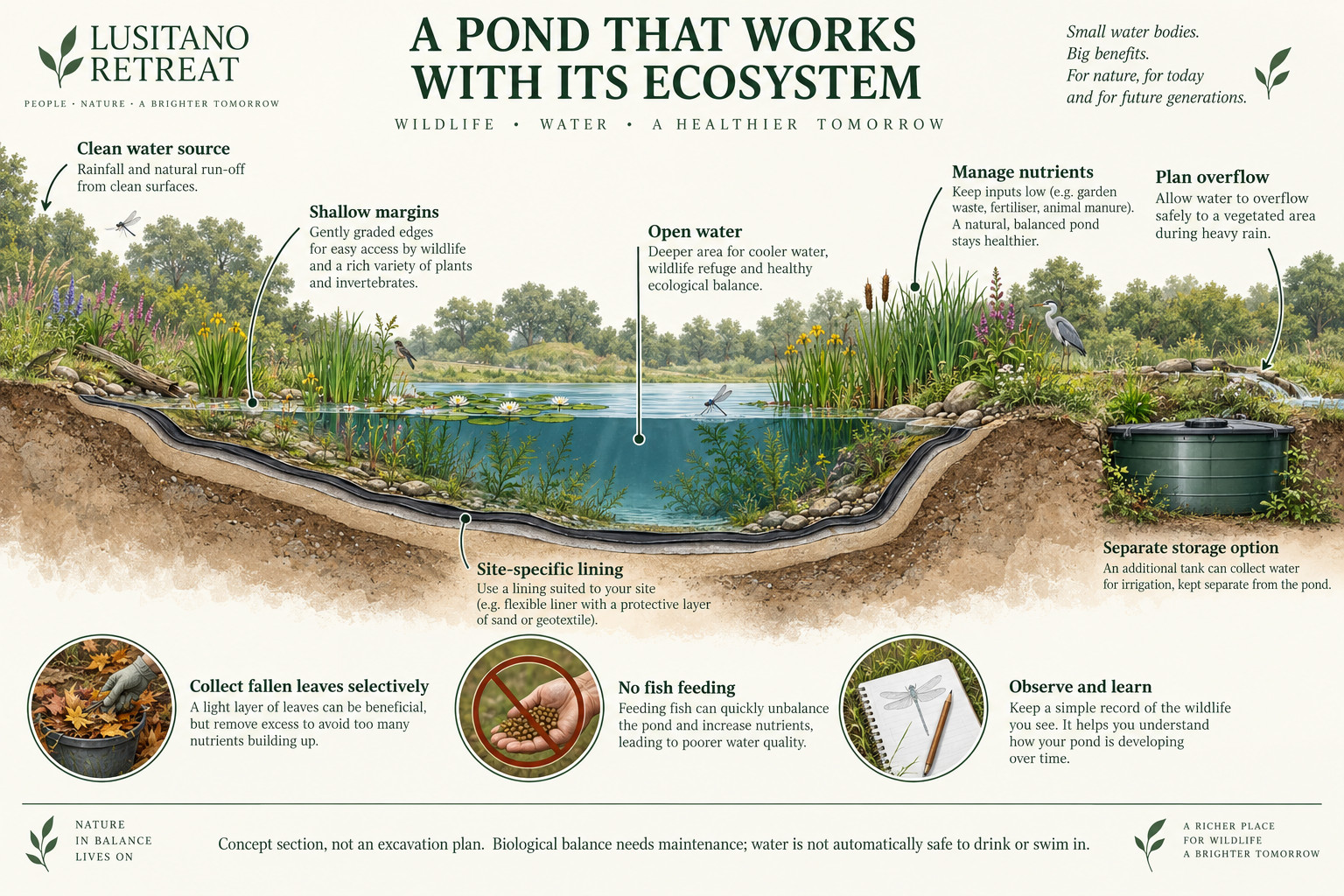
Choose a varied profile rather than a uniform steep-sided hole. RHS describes a long shallow side as useful for wildlife access and fluctuating water levels; its garden guidance gives depth examples, not a specification for a farm reservoir. Our design brief asks for shallow margins, wet ground and varied underwater habitat, with dimensions determined by the ecology, geology, hydrology and safety assessment. [P3]
Show both wet and dry conditions on the concept plan. An attractive edge at full level may become a slippery steep bank at low level. Keep guest routes, seating, observation points, machinery access and ecological refuge distinct. A shallow wildlife route is not a child-drowning prevention system. Structural retaining walls, decks, jetties and bridges require their own design; reclaimed pallets are not a default solution over water.
Ask whether several smaller habitat basins would perform better than one large multifunction basin. They can allow different seasonal behaviour and reduce the temptation to manage every part for a single visual effect. This remains an alternative to assess, not permission to multiply earthworks.
| Concept zone | Potential role | Design question |
|---|---|---|
| Damp landward margin | Transition habitat and sheltered vegetation | How will it behave at seasonal low level? |
| Very shallow edge | Access and varied microhabitat | What stable profile suits this ground? |
| Marginal planting area | Cover and plant establishment | Which species fit local water and soil? |
| Open water and deeper area | Habitat variety and water reserve | Is the depth justified by the primary job? |
| Landward observation point | Guests enjoy the pond without entry | What barrier and route are appropriate? |
| Separate overflow corridor | Manage excess water | Where can water lawfully go without harm? |
09 / The research
Choose earth, clay or a manufactured liner from evidence
An unlined excavation is worth considering only where assessed soil and water conditions can support the intended hydroperiod. Clay-based approaches depend on suitable material, preparation and construction control. A manufactured liner depends on substrate preparation, protection, penetrations, edges, compatibility and repair access. None is universally cheapest when rework and losses are included.
Request comparable options showing assumptions, excavation volume, imported material, spoil destination, machinery access and expected inspection needs. Ask how groundwater uplift, settlement, roots, sharp stones and changing water levels are addressed where relevant. Specify who is responsible if the chosen construction fails to hold the intended water level, and how that is distinguished from expected seasonal variation.
For a lined option, obtain the selected product manufacturer’s installation instructions and suitability evidence. Let the designer specify protection layers and anchoring for the actual site. Do not substitute a reclaimed advertising banner, unknown roofing membrane or damaged second-hand liner without material and condition evidence. Buying one critical new waterproofing component can be more responsible than wasting excavation and water around an unsuitable reused one.
Take dated photographs of the prepared base and installed layers before they are concealed. Record product, batch where relevant, installer and any repairs. Keep heavy machinery away from completed edges and agree the filling sequence with the contractor. This is a quality-record workflow; it does not prescribe liner thickness, compaction passes or earth-bank slopes.
10 / The research
Establish plants without importing a problem
Choose plants for local conditions and the designed water regime, using reputable suppliers and botanical names. RHS recommends suitable planting within and around a wildlife pond; avoid imposing a single universal percentage of plant cover on every habitat. A species useful in one pond can dominate another. Record expected spread and how maintenance access will work before planting. [P3]
Do not move pond water, fish, spawn, sediment or unverified plant bundles from another pond to accelerate establishment. A supplier label should be checked against invasive-species guidance, and equipment should be cleaned appropriately between waters. Government guidance warns that small invasive plant fragments can spread during maintenance and disposal. Do not dump unwanted aquatic growth in a ditch or neighbouring waterbody. [P9]
For this wildlife baseline, do not add fish as an algae-control or mosquito-control shortcut. Fish production is a different brief, and stocking can alter the habitat. Investigate a mosquito concern through observation, management of avoidable containers and relevant specialist advice rather than adding insecticides or animals without an ecological assessment. Covered service tanks and unmanaged small containers should be reviewed separately from the designed pond.
Photograph establishment from fixed positions and keep a plant ledger: source, identity, intended zone, planting date and observed behaviour. Allow natural colonisation where appropriate to the ecological plan. Success is the developing habitat and manageable care, not a staged photograph made by importing a mature ecosystem from elsewhere.
11 / The research
Decide whether equipment solves a real requirement
A fish-free wildlife pond need not be built around a pump and mechanical filter; RHS explicitly says a wildlife pond does not need a filter. If a cascade is desired, consider its energy, wildlife protection and maintenance instead of treating moving water as automatic proof of cleanliness. [P3]
An engineered recirculating wetland or filtration system is a separate option requiring a stated design load, hydraulic route, access for maintenance, failure response and performance criteria. A drawing of water flowing through gravel does not establish pathogen removal, bathing suitability or reliable nutrient control. Ask the designer what is being removed, where it goes and how performance is demonstrated.
If a pump or aerator is essential to the chosen use, include electrical design by a competent person, isolation for maintenance and a loss-of-power response. Solar output and daily energy calculations do not demonstrate overnight reliability. Cross-check the retreat energy guide using actual equipment data. No electrical connection or pump specification is supplied here.
Compare lifetime operation as well as installation: power, consumables, replacement parts, noise, access and someone being available to inspect faults. Prefer the simplest system that meets the defined requirement, while retaining the option to choose no powered equipment when ecology and use allow.
12 / The research
Construction in gated phases
Phase 1 is evidence: complete the site brief, ecology, levels, ground and water assessment, then compare alternatives. Phase 2 is the written design and permissions position, including spoil, overflow, access and public safety. Stop before excavation if the design still depends on an unidentified water source, an assumed ditch outlet or an untested bank construction.
Phase 3 is site preparation under the agreed method. Mark services and exclusion areas, protect existing habitats, plan machinery movements and arrange lawful handling of excavated material. Phase 4 is excavation and base construction to the reviewed design, with inspection points before work is covered. Photograph the profile and important levels using a common reference so that a later water-level problem can be investigated.
Phase 5 is completion of containment, edges, access controls and overflow arrangements before filling or guest access. Phase 6 is filling from the assessed lawful source, checking behaviour and addressing defects through the contractor. Phase 7 is planting and ecological establishment, followed by observation through contrasting weather. Do not announce the pond as an operating swimming facility after a visual fill test.
For the programme, film the notebook, ground-level setting-out, material decisions, contractor explanation and repeated safe-position observations. The 21-chapter story can show a decision or a small safe trial; it does not promise a mature pond in 21 days. Chapters 10, 11 and 12 naturally connect water functions, weather evidence and the growing landscape.
13 / The research
Care, algae and the conditions that trigger action
Prepare a seasonal inspection sheet covering level, overflow condition, bank changes, access controls, plant spread, visible pollution and any equipment. RHS advises occasional care while avoiding unnecessary complete clean-outs. The timing and scale of work should respect wildlife and protected species. Make incremental interventions and record their effect rather than stripping the entire pond whenever it looks untidy. [P10]
When algae becomes troublesome, investigate changes in nutrient inputs, shade, organic accumulation and use. Do not assume a bottle of treatment corrects the catchment. Pond ecology can include algae without being broken, while a concerning bloom requires a different response. EA advises that potentially toxic blooms cannot be identified as safe by appearance; restrict contact by people and animals and seek appropriate advice. [P14]
Write separate responses for suspected pollution, an unexpected rapid drop, a blocked overflow, new bank cracks and equipment failure. Record who isolates access, who investigates and what evidence is needed before reopening. An operating retreat needs a named responsible person even during quiet weeks. Do not climb into a basin, walk on ice or attempt a water rescue without appropriate training and equipment.
Defer any promise of drinking-water use. Ecological appearance and a planted filter do not establish potable quality. Similarly, a good wildlife record is not microbiological evidence for bathing. A change in intended use reopens the design and management assessment rather than simply changing the sign.
14 / The research
Contractor brief, cost categories and the next decision
Send prospective designers the same brief so their proposals can be compared. Include the primary job, location and parcel constraints, evidence collected, unknowns, seasonal storage target if relevant, visitor profile and intended programme filming. Ask for the scope of surveys, drawings, permissions support, construction supervision, commissioning and maintenance guidance. Identify exclusions and the point at which a fixed quotation can be meaningful.
Build a cost ledger by category: surveys and advice; permission/application costs; excavation and access; spoil handling; containment and protection; overflow and drainage works; suitable plants; safety and paths; optional equipment and electrical work; commissioning; annual care; and contingency for specifically identified uncertainties. Obtain actual local quotes on a consistent VAT basis. No per-square-metre price, investment return or universal contingency percentage is supported for our unselected site.
The first decision is whether the ambition is mainly wildlife, reliable stored water or swimming. The second is whether an existing pond can be retained with gentle improvements instead of constructing a new one. The third is the measured site and permissions route. Only after those decisions should the team choose dimensions, materials and a construction budget.
The practical deliverable for now is a due-diligence pack: one map, a water-balance worksheet, ground and ecology questions, alternative designs, an approvals matrix, comparable contractor scopes and an operating care plan. Keep unknowns visible. That creates a credible retreat project and a useful episode even before a machine arrives.
- Ask who signs off the design and who inspects concealed work.
- Request a level/volume drawing and the safe destination of overflow.
- Ask for dry-season behaviour, fault response and maintenance access.
- Confirm what the quotation excludes and who owns remedial work.
- Include access control and supervision before any visitor use; a shallow edge or a sign alone is insufficient. RoSPA recommends practical barriers or suitable rigid covers, regular checks and close supervision of young children. [P15]